

Affiliation Disclosure & Disclaimer:
The managing principal of Ridire Research is affiliated with a private investment fund that holds long positions in the securities discussed herein (Shoucheng Holdings, 697 HK), which could influence the views expressed. This publication is for educational and informational purposes only. Any performance referenced is illustrative and tracked on a per-article basis, not as part of a model portfolio or investment program. Nothing herein constitutes investment advice, a recommendation, or a solicitation. → Ridire Research Substack Disclaimer
Table of Contents
Executive Summary
Company Overview
The Setup
Causal Mechanism
Timeline
Key Risks
Conclusion
Executive Summary
Shoucheng Holdings (697 HK) is becoming a listed proxy for China’s robotics commercialization stack. It is a listed platform with indirect exposure to one of China’s most visible robotics champions (Unitree), plus operating infrastructure that can help robotics companies move from prototype to sales, service, deployment, and field data.
The center of the thesis is Unitree:
Unitree has cleared the Shanghai Stock Exchange listing committee review, and its prospectus identifies the Beijing Robot Industry Development Investment Fund as a pre-IPO shareholder.
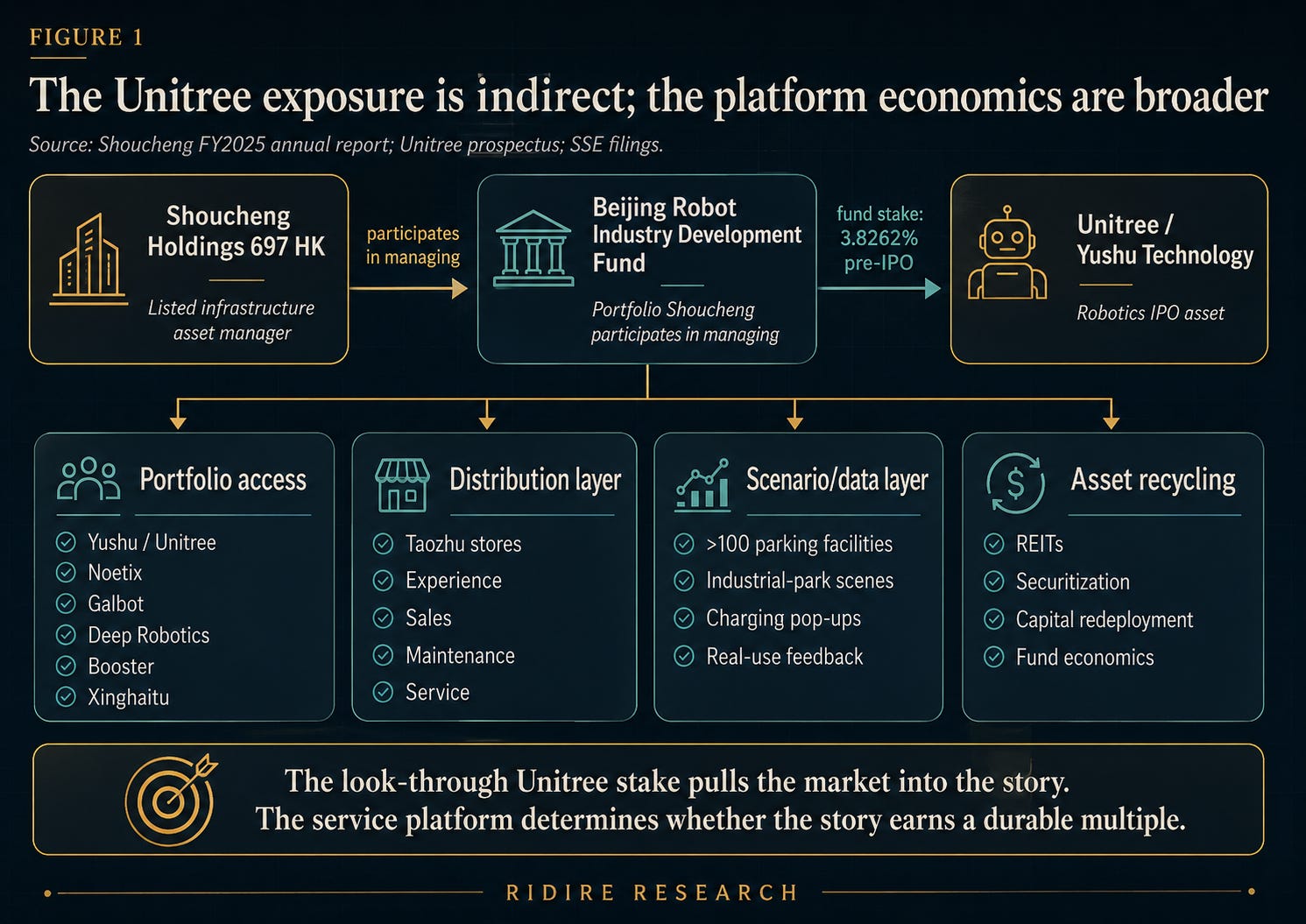
Shoucheng says it participates in managing that fund’s portfolio and has concentrated investments across more than 20 robotics and embodied-intelligence companies. The market-facing asset is therefore not a parking operator with a robotics footnote.
The setup became sharper after Unitree’s IPO process advanced.
Xinhua reported that Unitree’s IPO application passed SSE listing review on June 1, 2026, with 2025 revenue of roughly RMB1.7 billion and expected 1H 2026 revenue above RMB1.0 billion.
The IPO plans to raise funds for robot model R&D, robot body R&D, new product development, and a manufacturing base.
The investment question is now operational: can Shoucheng turn robotics exposure into visible economics through fund marks, Taozhu retail/service channels, deployment sites, maintenance, charging, dispatch, and asset recycling?
Company Overview
Shoucheng describes itself as a service provider for China’s intelligent infrastructure assets. The company’s two core engines are industrial funds and asset operation, but the strategic direction is increasingly organized around a robotics ecosystem: capital, scenarios, supply-chain integration, commercialization, and asset-management exits.
The robotics exposure is broader than Unitree:
Shoucheng’s annual report lists a portfolio spanning Yushu Technology / Unitree, Noetix Robotics, Galbot, Deep Robotics, Booster Robotics, Xinghaitu, TowardPi Medical, Rossum Robot, X-magtech, Wisson, Volant, Differential Robotics, Matrix Technology, MOTOREVO Robotics, ROBOTERA, MarveLab, and others.
The listed fields include embodied intelligence, humanoid robots, medical robots, industrial robots, low-altitude economy, core robotics components, and consumer robots.
Shoucheng’s own disclosure says the Beijing Robot Industry Development Investment Fund portfolio, which the company participates in managing, increased by approximately 4x. That is not the same as cash realization, but it gives the stock a direct reason to trade with the private robotics cycle.
The Setup
In simplest terms the setup is Unitree visibility plus China robotics scale.
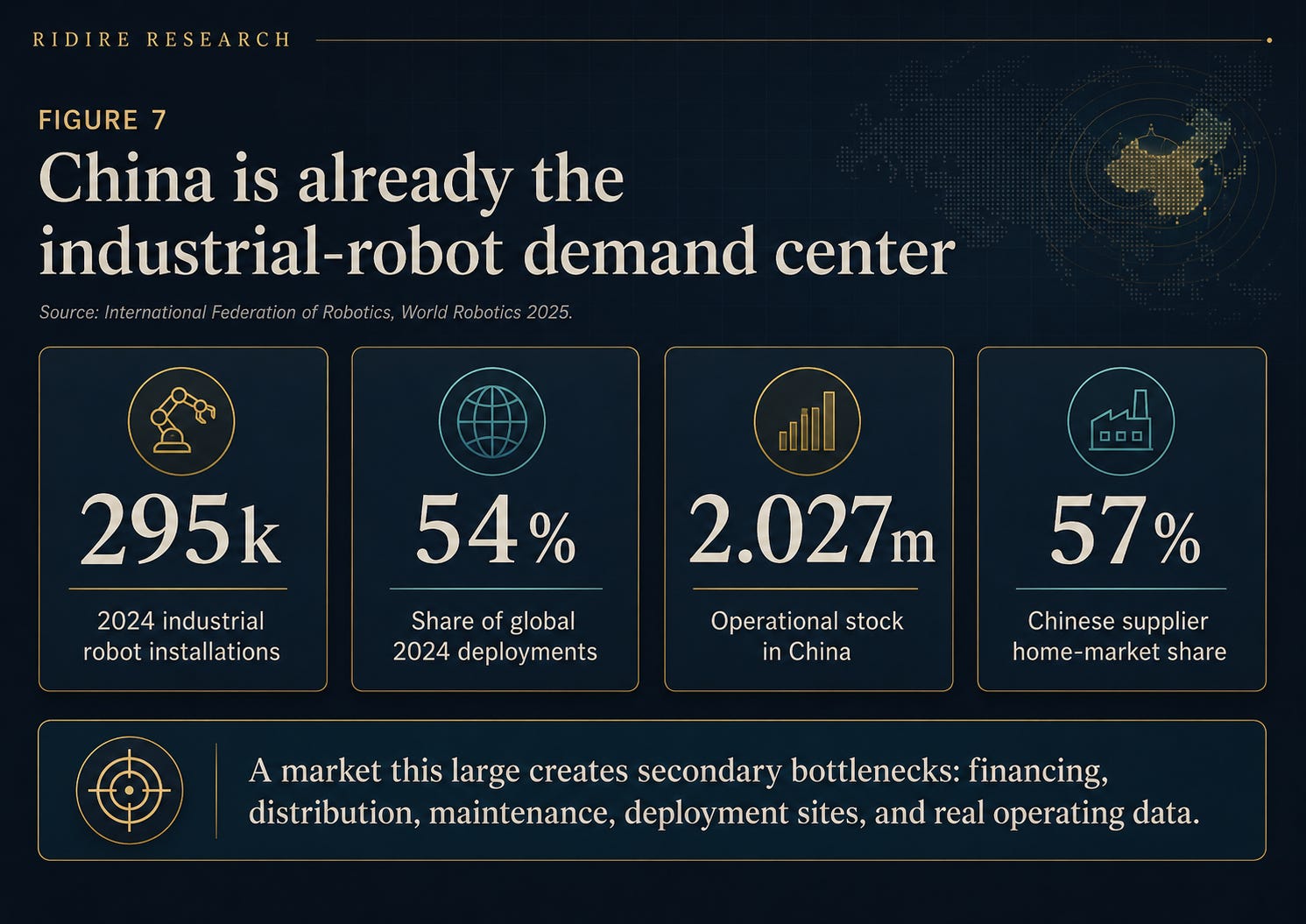
China is already the largest industrial robot deployment market globally. The International Federation of Robotics reported that China accounted for 54% of global industrial robot deployments in 2024, with roughly 295,000 annual installations and more than 2 million industrial robots in operation. Chinese manufacturers also reached a record domestic market share of 57%.
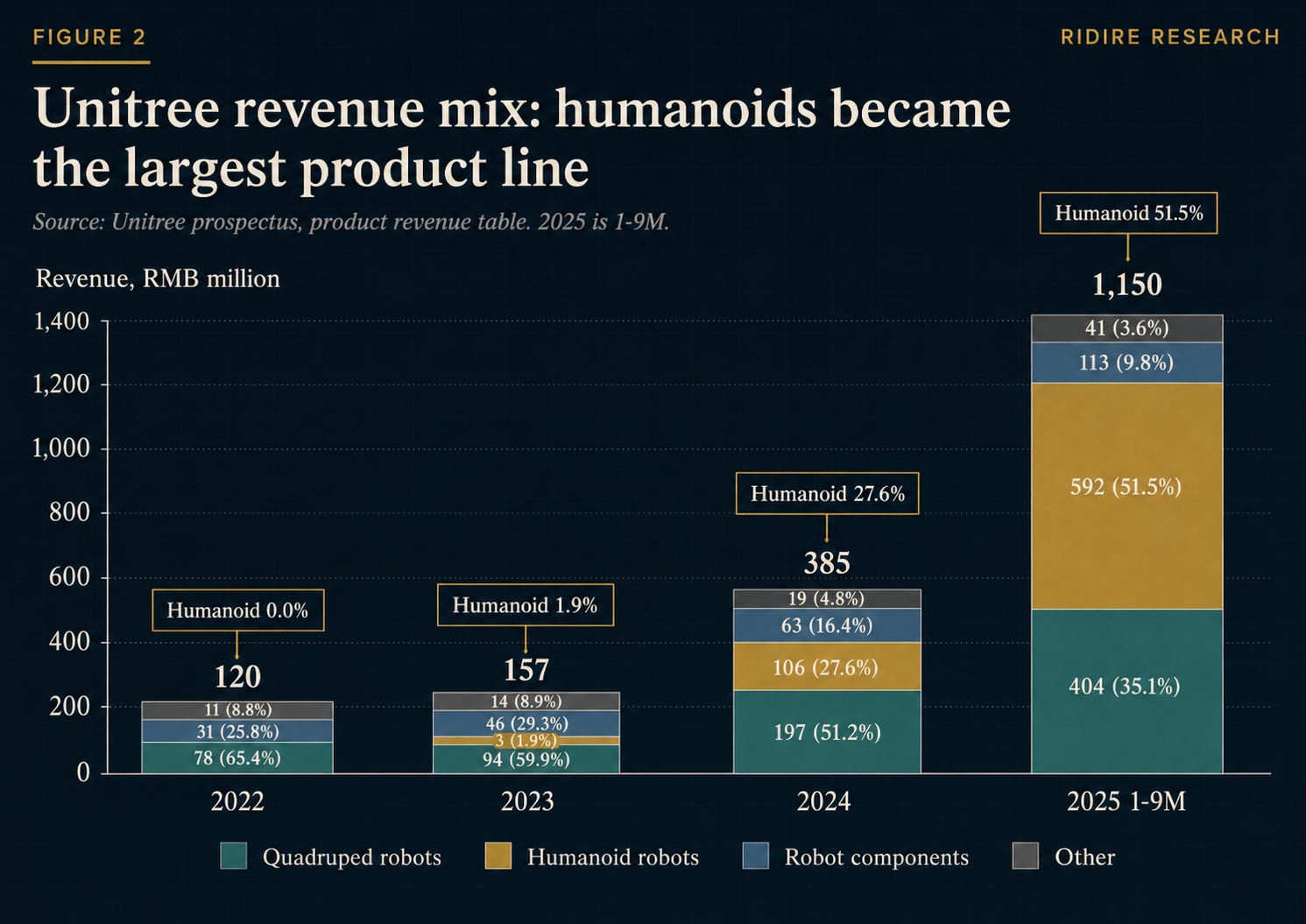
Unitree gives the Shoucheng thesis a visible flagship. Unitree’s prospectus shows humanoid robot revenue moved from a negligible share in 2023 to the largest reported product category in the first nine months of 2025. For 2025 1–9M, humanoid robots were 51.53% of product revenue, quadruped robots were 42.25%, and components were 5.76%.
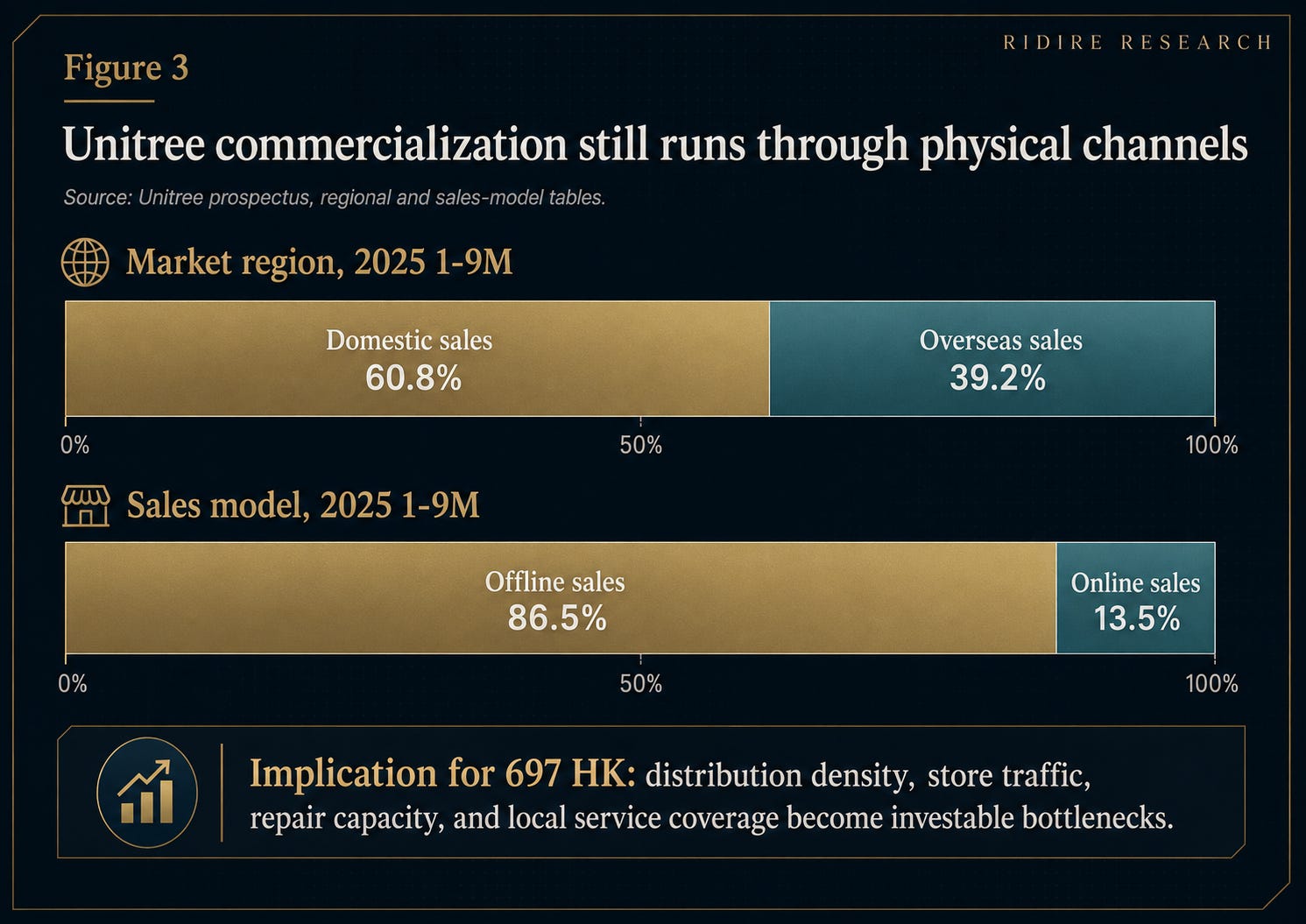
The next layer is channel and service density. Unitree’s prospectus shows sales remain heavily offline: for 2025 1–9M, offline sales represented 86.50% of revenue, while online sales represented 13.50%. Domestic sales were 60.80%, with overseas at 39.20%.
That is where Shoucheng’s physical assets enter the story. Robotics commercialization still needs demo floors, service points, repair capacity, training environments, charging locations, field data, and enterprise customer access.
Causal Mechanism
1. Unitree makes the robotics portfolio legible
Unitree is the recognizability layer. The fund stake gives public-market investors a concrete way to think about Shoucheng’s robotics exposure. The Beijing Robot Industry Development Investment Fund appears in Unitree’s shareholder table with 3.8262% pre-IPO ownership, and Shoucheng says it participates in managing the same fund’s portfolio.
2. Taozhu gives the portfolio an offline channel
Shoucheng’s Taozhu New Manufacturing Bureau is the commercial testbed. The company says Taozhu integrates robot experience, sales, maintenance, and service. It has opened Beijing stores including Shougang Park Rongshi Plaza, Beijing Capital Airport Terminal 2, Beijing Capital Airport Terminal 3, and Wangfujing APM. Shoucheng also says nearly 100 robotics companies have signed as authorized agents, covering industrial robots, service robots, and intelligent solutions.
The Taozhu KPI is not really store count. The KPI is whether those stores become a lower-friction path from robotics manufacturer to customer: product trial, purchase, installation, maintenance, and repeat service.
3. Parking sites become robot service locations
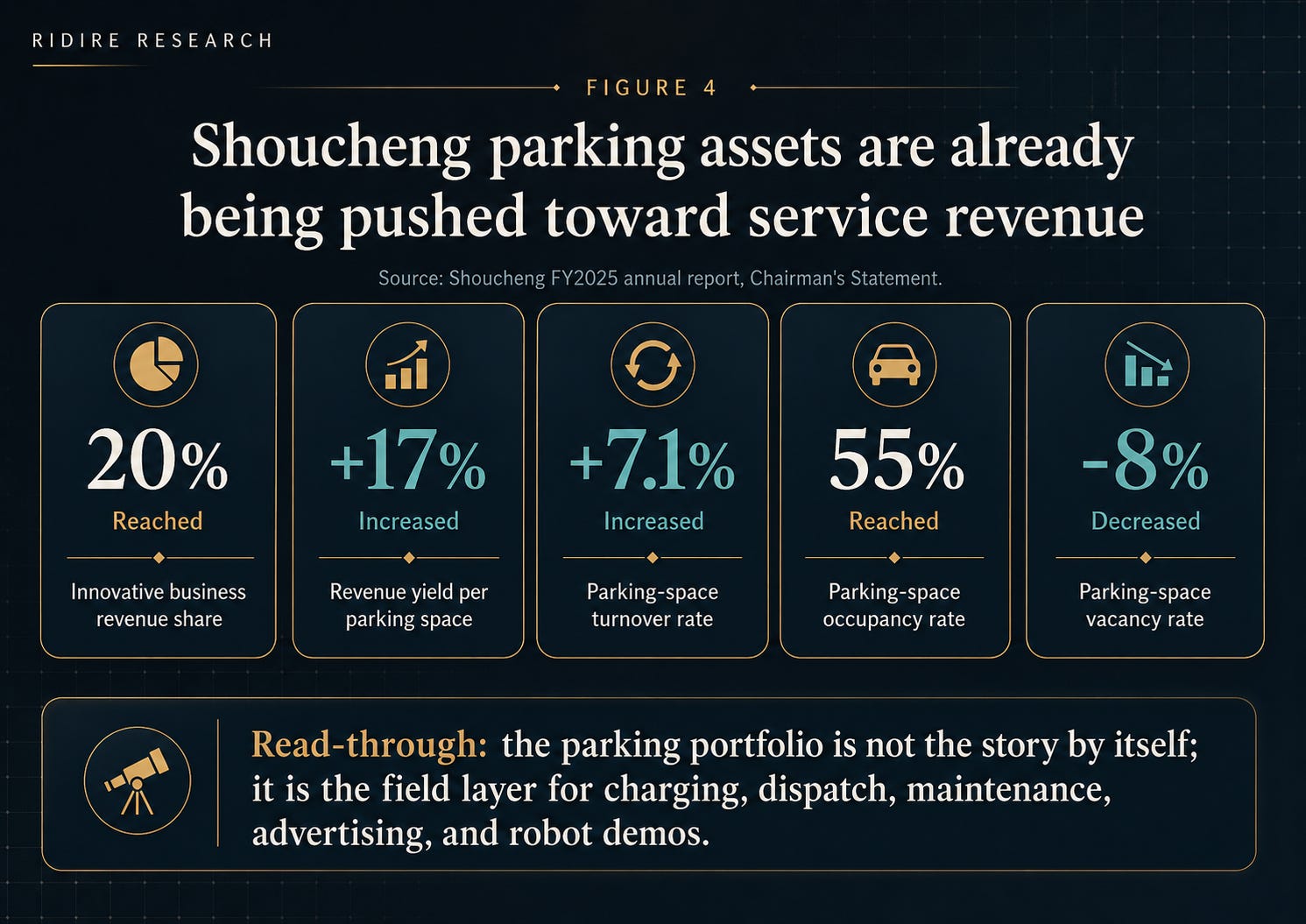
Shoucheng’s parking disclosures have started to move toward service revenue. The company says static traffic assets are evolving from parking fees toward multi-format commercial revenue. Disclosed operating KPIs include innovative business revenue contribution of 20%, revenue yield per space up 17%, turnover up 7.1%, and vacancy down 8%.
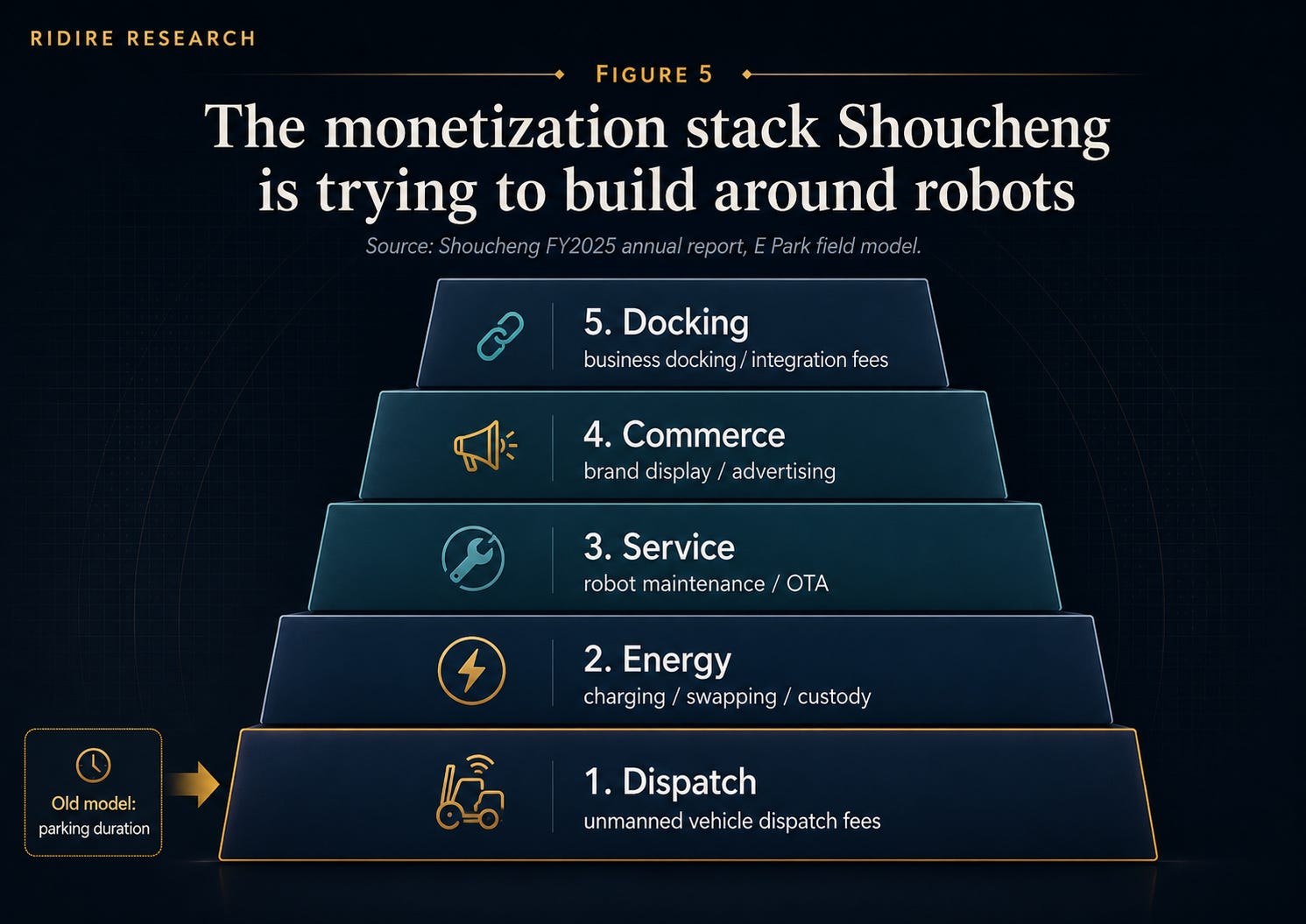
The company also lays out the robot-field services explicitly: dispatch fees, robot charging / swapping / custody fees, maintenance and OTA services, commerce and advertising, and intelligent business docking fees. Management describes a shift toward charging, operation, maintenance, and dispatching, using parking lots as distributed nodes for unmanned-vehicle closed-loop operations.
4. Industrial parks provide real deployment data
Shoucheng says it manages more than 100 parking facilities and millions of square meters of industrial parks across Beijing-Tianjin-Hebei, Chengdu-Chongqing, East China, and the Greater Bay Area. The company states these assets can provide robotics companies with real operational data. It also disclosed an automatic charging robot pop-up store with Wisson at Chengdu ICD Mall, tied to a “parking + charging” model.
In other words Shoucheng is not only a financial investor in robotics companies. It can offer commercial scenes, physical traffic, operating data, service density, and customer touchpoints.
5. REITs and securitization create the exit route
The REIT layer is supporting infrastructure. Shoucheng has disclosed infrastructure funds and REIT-related strategies across technology parks, data centers, consumer infrastructure, clean energy, and urban development assets. The company’s model is to invest, operate, improve, securitize or exit, and retain fee-bearing economics where possible. The robotics platform becomes more attractive if deployment sites can be improved, monetized, and recycled rather than sitting permanently on balance sheet.
Timeline
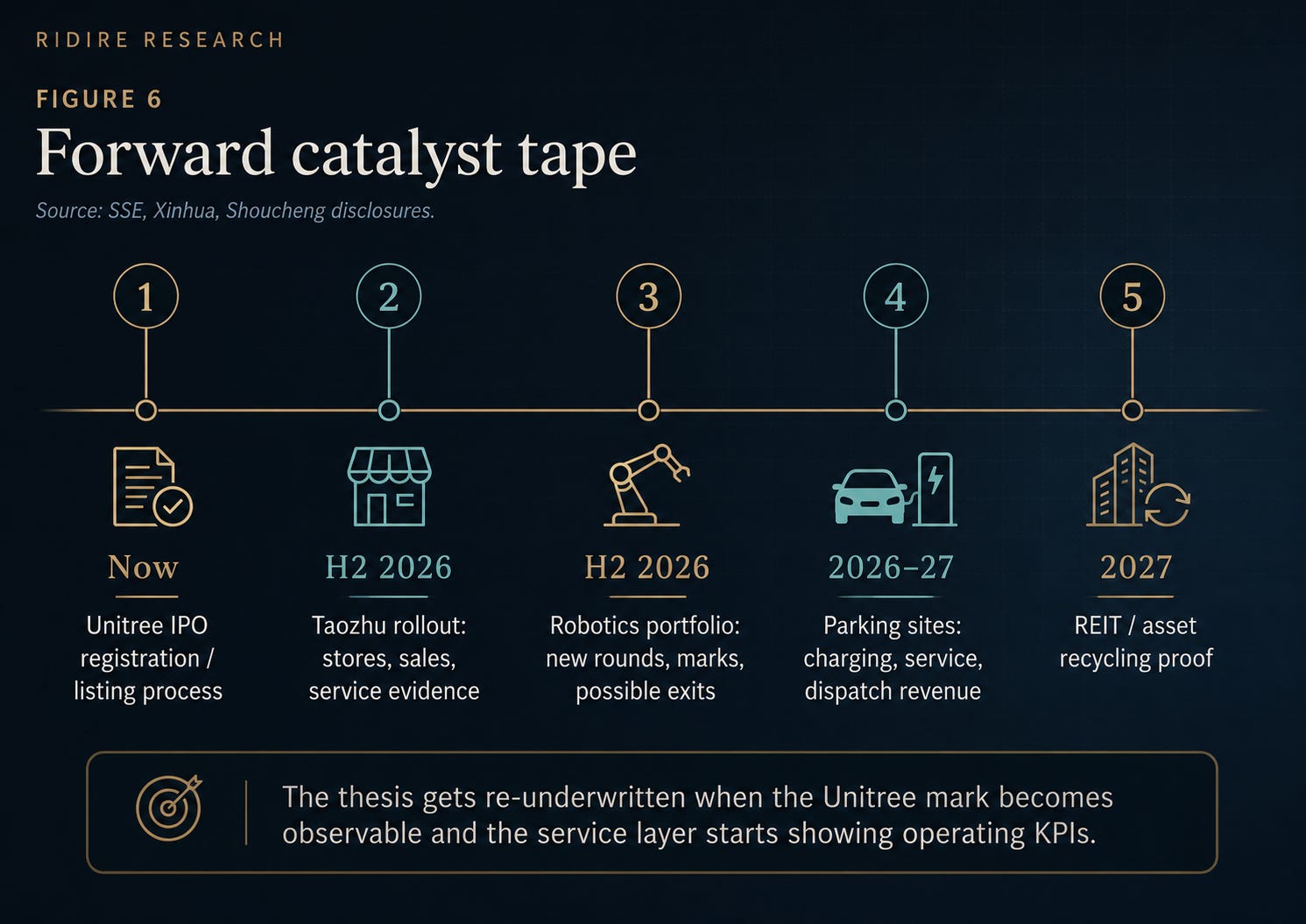
The Unitree review already cleared the first public gate. The Shanghai Stock Exchange listing committee announced that Unitree met issuance, listing, and information-disclosure requirements, while also asking follow-up questions on commercialization, competition, downstream demand, technology differences, future R&D, expenses, and performance volatility.
Key Risks
1. Unitree exposure is indirect
Shoucheng has not disclosed a simple direct stake in Unitree at the parent-company level. The exposure runs through fund structures. The Beijing Robot Industry Development Investment Fund is listed as a Unitree shareholder, and Shoucheng says it participates in managing that fund’s portfolio. The economics may be diluted by fund terms, lock-ups, carry structures, minority ownership, and distribution timing.
2. IPO approval does not equal cash realization
SSE listing committee approval is a major milestone, but it is not the same as final registration, pricing, listing, or post-lock-up liquidity. The public-market value assigned to Unitree will drive perception, but Shoucheng’s realized economics depend on the fund’s ownership, holding period, exit path, and accounting treatment.
3. Robotics adoption can stay demonstration-heavy
Unitree’s growth is impressive, and the humanoid mix shift is visible. The harder underwriting question is recurring commercial deployment. The SSE committee’s questions on application fields, commercialization progress, competition, downstream demand, and future performance volatility point directly at the unresolved issues.
4. Taozhu needs store economics
Taozhu has strong locations and nearly 100 authorized robotics partners, but public disclosures still need harder commercial KPIs: GMV, conversion, gross margin, service revenue, repair volume, and repeat customer activity. Store count alone is not enough.
5. Parking-site monetization may take longer than expected
Shoucheng has disclosed the right service categories: charging, dispatch, maintenance, OTA, advertising, and business docking. The proof will be segment revenue. Until those services appear in numbers, the parking-infrastructure leg remains a forward operating claim.
6. Fund marks are not distributions
The reported fourfold increase in the Beijing robotics fund portfolio is strategically important. It still needs to convert into realized gains, recurring management economics, or cash distributions before it can support a durable re-rating.
Conclusion
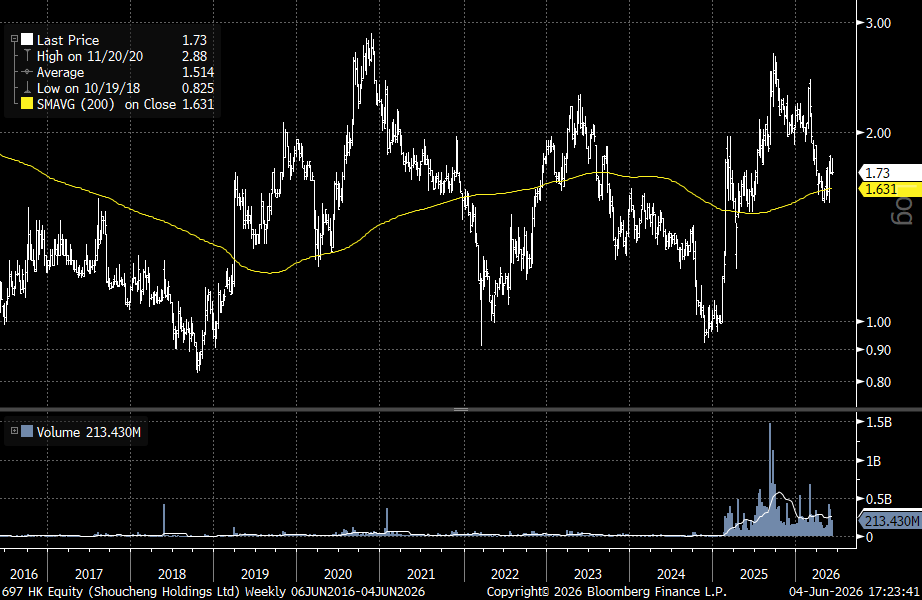
Shoucheng’s most interesting asset is its position inside China’s robotics funding and commercialization network. The Unitree look-through stake makes the story visible. Taozhu, parking facilities, industrial parks, charging sites, maintenance channels, and REIT exits explain how that visibility can become operating economics.
The stock works if three things happen over the next 12–24 months:
Unitree becomes a liquid valuation anchor,
Taozhu shows real sales and service activity,
and Shoucheng’s physical sites begin reporting robotics-linked revenue.
Without those proofs, 697 HK remains a listed infrastructure/fund platform with a robotics narrative. With them, it becomes one of the cleaner Hong Kong-listed rails into China’s robotics commercialization cycle.