


Affiliation Disclosure & Disclaimer:
The managing principal of Ridire Research is affiliated with a private investment fund that holds long positions in the securities discussed herein (AM US) which could influence the views expressed. This publication is for educational and informational purposes only. Any performance referenced is illustrative and tracked on a per-article basis, not as part of a model portfolio or investment program. Nothing herein constitutes investment advice, a recommendation, or a solicitation. → Ridire Research Substack Disclaimer

Table of Contents
Executive Summary
Company Overview
The Setup
Causal Mechanism
Timeline
Key Risks
Conclusion
Executive Summary
Antero Midstream (AM US, $10.2b market cap) is usually reduced to a simple label: a single-customer Appalachian midstream company tied to Antero Resources.
AM’s dependence on Antero Resources is the central risk in the story, but it also creates an unusual operating advantage:
Substantially all of AR’s current and future Appalachian acreage is dedicated to AM for gathering and compression, and the two companies coordinate development and infrastructure planning.
AM is therefore not building speculative pipe and waiting for third-party volumes. It is building against a visible drilling schedule, on acreage controlled by the producer responsible for almost all of its throughput.
In addition, the asset base has changed:
AM closed the HG Midstream acquisition in February 2026, adding gathering and integrated water infrastructure in the core Marcellus, while divesting non-core Utica assets later that month. The company traded geographic breadth for density around AR’s highest-priority inventory.
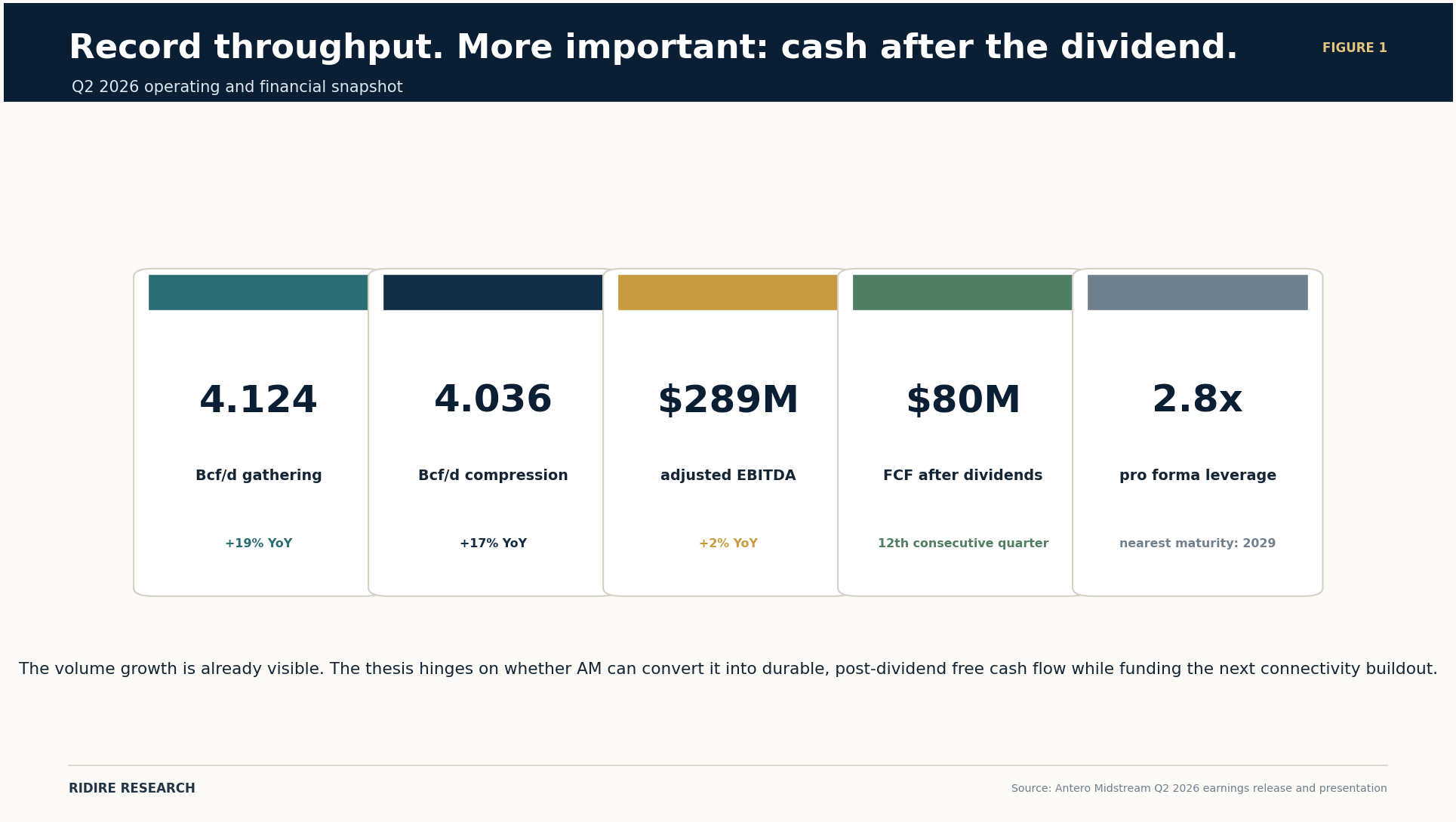
The first full quarter of the new footprint produced record gathering volumes of 4.124 Bcf/d, up 19% year over year, and compression volumes of 4.036 Bcf/d, up 17%.
The quarter was not a clean operating-leverage print. Adjusted EBITDA rose only 2%, fresh-water delivery declined 16%, high-pressure gathering declined 7%, and acquired water volumes carried a different cost profile.
However our thesis is that AM can integrate the new footprint, shift activity toward higher-value services, and preserve free cash flow after the dividend while funding a new regional connectivity layer.
East Side Express is a strategic bridge:
AM has begun construction on its first intrastate regional pipeline, a bi-directional system intended to connect dry-gas supply with multiple long-haul and regional pipelines and local markets. Management presents the project as the infrastructure companion to roughly 700 future dry-gas locations and early well results that are materially better than legacy offsets.
If the project works, AM moves one step beyond captive gathering: it remains anchored by AR, but gains more routing flexibility and a longer runway for dry-gas development.
The balance sheet is no longer the gating issue it was:
AM generated $80 million of adjusted free cash flow after dividends in Q2, its twelfth consecutive positive quarter on that measure. In July, it received approximately $371 million from the Veolia litigation and used the proceeds, together with revolver borrowings, to call the $650 million notes due in 2028. Pro forma leverage fell to 2.8x, liquidity exceeded $600 million, and the nearest maturity moved to 2029.
The variant view is straightforward: What looks like customer concentration can also function as infrastructure coordination. AM does not need AR to pursue unconstrained growth. It needs AR to keep drilling the dedicated core, the HG integration to convert into better water and compression economics, and East Side Express to turn dry-gas inventory into regional connectivity. If those pieces align, AM becomes less a static gathering utility and more a toll road built directly into its customer’s development plan.
Company Overview
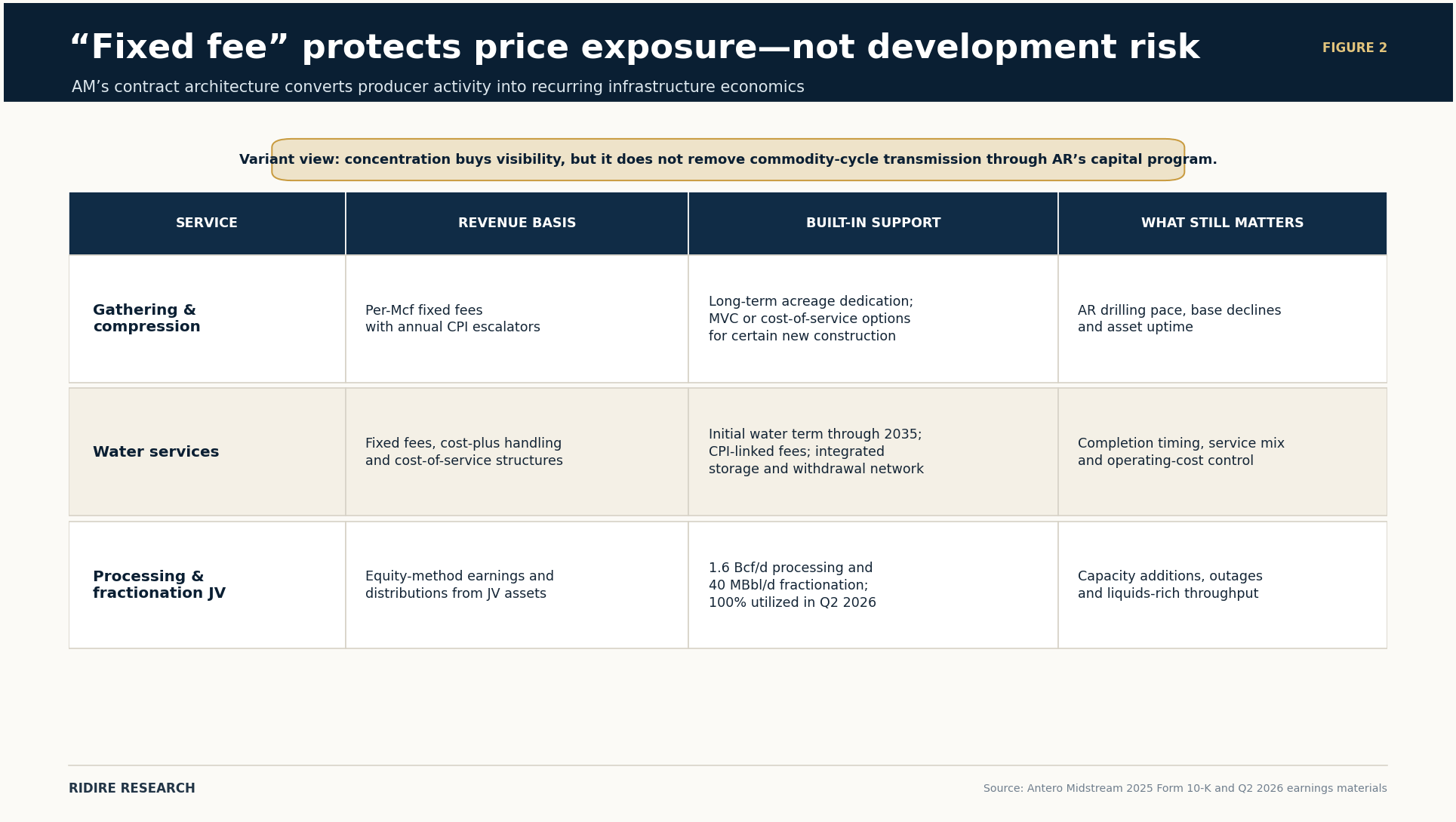
Antero Midstream operates the infrastructure between the wellhead and the downstream market. Its system includes low-pressure gathering, well-pad and centralized compression, high-pressure gathering, water delivery and handling, and equity interests in processing and fractionation facilities. The company reports two operating segments: Gathering and Processing, and Water Handling.
The physical footprint is substantial but concentrated. AM reports 731 miles of gathering pipeline, 4.8 Bcf/d of compression capacity and 1.6 Bcf/d of joint-venture processing capacity. In Q2 2026, the processing joint venture also ran 40 MBbl/d of fractionation volume, with both processing and fractionation capacity fully utilized.
AM earns per-unit fees on gathering, compression and water services rather than taking direct ownership of the commodity. Most relevant gathering and water fees include annual CPI adjustments. Certain new gathering and compression assets requested by AR can be supported either by minimum-volume commitments or by a cost-of-service mechanism. Long-term acreage dedications cover substantially all of AR’s current and future Appalachian acreage.
This creates a business with limited direct commodity-price exposure but meaningful indirect exposure. Lower natural-gas or NGL prices do not mechanically reduce AM’s fee per unit. They can still influence AR’s drilling schedule, completion timing and production trajectory.
AM’s economic engine is therefore best understood as volume × service intensity × contract structure, not as a direct bet on the spot price of natural gas. The company’s most important asset is the development map it shares with AR.
The Setup
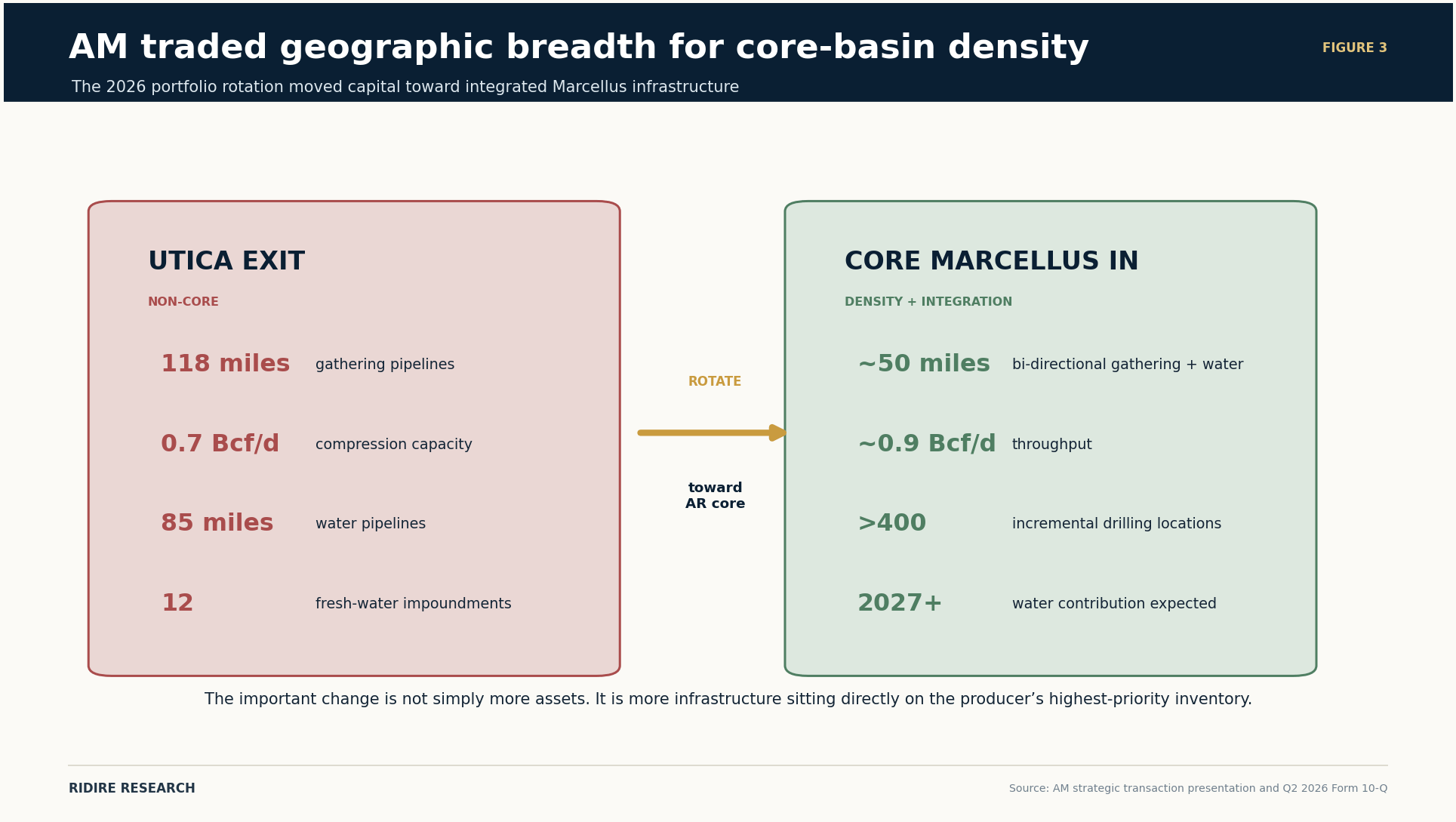
The setup begins with a portfolio rotation:
AM acquired HG Midstream on February 3, 2026. The assets sit in the core Marcellus in West Virginia and include gathering pipelines and integrated water infrastructure. From closing through June 30, the acquired operation contributed $61.2 million of revenue and $12.4 million of net income, including transaction expense. AM and AR are also modifying their commercial arrangements to incorporate well-pad compression and water services associated with the acquired acreage.
Twenty days later, AM closed the sale of substantially all of its Utica midstream assets. The disposed footprint included 118 miles of gathering pipelines, 0.7 Bcfe/d of compression capacity, 85 miles of water pipelines and 12 water impoundments. The proceeds were used to reduce debt.
AM exited a separate Ohio footprint and added infrastructure embedded in AR’s core West Virginia development area. The result is a more concentrated system. In midstream, density can improve planning, increase asset reuse, and make incremental projects easier to sequence around a known drilling program. The potential advantage is that every dollar of infrastructure capital is aimed at the customer most likely to use it.
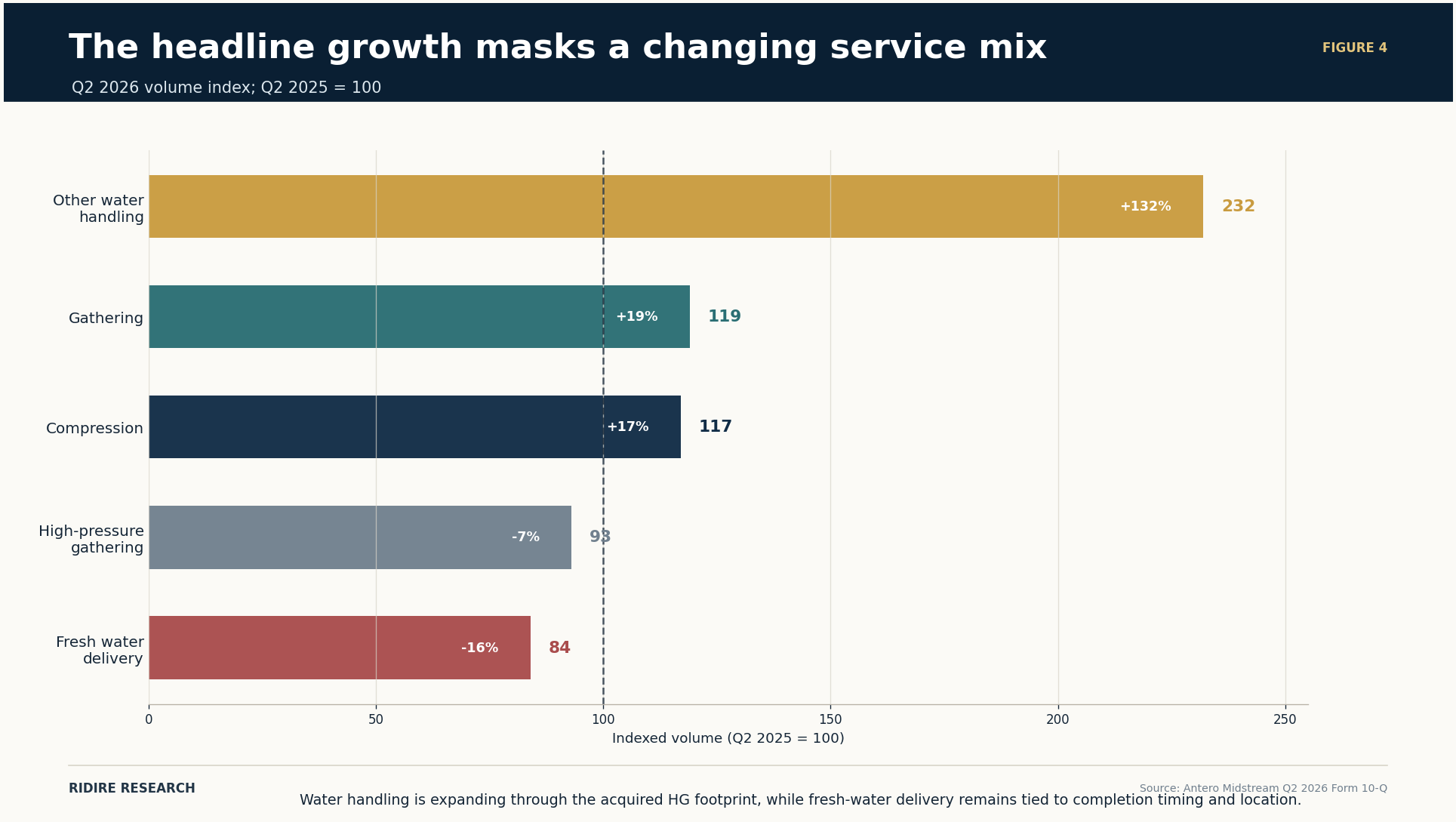
The Q2 operating data show the first-order effect: Gathering volume rose 19% and compression volume rose 17%. The HG acquisition and 80 connected wells drove the increase, partially offset by the Utica sale and natural declines. The mix underneath the headline:
Well-pad compression, a new reported category following the HG acquisition, averaged 747 MMcf/d.
Centralized compression declined 5%.
High-pressure gathering declined 7%, primarily reflecting the Utica divestiture and natural decline.
Fresh-water delivery declined 16% because of completion timing and location.
Other water handling increased 131%, largely because water delivered on the HG acreage is currently charged at cost plus 3%, alongside higher blending, trucking and disposal activity.
This is why volume growth and EBITDA growth diverged. Some acquired throughput arrived with additional operating expense. Some high-pressure activity left with the Utica assets. Water activity shifted from the legacy fixed-fee delivery category into cost-plus and cost-of-service categories. Direct operating expense increased 34% year over year, while adjusted EBITDA increased 2%.
AM now has more throughput, but management must prove that integration, commercial restructuring and service layering can improve the earnings content of that throughput.
The sponsor backdrop is supportive. AR produced a record 4.144 Bcfe/d in Q2, up 21% year over year, raised full-year production guidance to 4.15–4.2 Bcfe/d, and guided to higher sequential production in the second half. More production and more connected wells create more opportunities to gather, compress and handle water across the dedicated footprint.
The setup therefore has three legs:
A larger core footprint: HG adds immediate gathering and compression throughput plus future water integration.
A cleaner capital structure: the Utica sale and Veolia proceeds reduced debt and pushed out the nearest maturity.
A new connectivity layer: East Side Express is intended to connect dry-gas supply with multiple regional and long-haul outlets.
Causal Mechanism
1. Customer concentration becomes planning visibility
Almost all of AM’s revenue comes from AR, but the concentration also creates unusual visibility. AR has dedicated substantially all of its current and future Appalachian acreage to AM, while AM’s capital program is built around AR’s drilling schedule.
That alignment enables a just-in-time infrastructure model. AM can see where wells are going, when they will be completed and what gathering, compression and water capacity they will require before deploying capital, rather than building ahead of uncertain third-party demand.
The causal chain is simple:
AR selects the next core development area → AM builds the required infrastructure → wells connect to the dedicated system → fixed fees convert throughput into recurring cash flow → new production data informs the next capital decision.
2. Contract structure converts commodity risk into activity risk
AM’s contracts are commodity-insulated, not commodity-independent.
AM is paid on volumes handled, not the market value of the molecules. Most gathering, compression and legacy water fees carry CPI escalators, while certain new high-pressure projects can receive either 10-year minimum-volume commitments or cost-of-service pricing targeting a 13% return over seven years.
But the protection is incomplete. Low-pressure gathering and water pipelines generally lack minimum commitments.
The fixed-fee model protects the unit rate; it does not guarantee the unit count.
AM is therefore best understood as a derivative of AR’s drilling economics, with contractual dampeners between commodity prices and cash flow.
3. Core density increases the value of service layering
The HG assets add more than gathering volume. They add well-pad compression and a broader water footprint around AR’s core acreage. AM plans to connect the acquired system with its legacy gathering and water network, with management expecting the water contribution to become more visible in 2027.
The opportunity is service layering. The same acreage can generate gathering, compression and water fees across the life of a well, increasing revenue density without requiring a new customer.
Q2 showed both the upside and the complication. Well-pad compression scaled quickly, while fresh-water delivery declined. Other water handling surged, but much of it was lower-quality cost-plus activity burdened by trucking, disposal and blending expense.
The integration thesis is not simply more water volume. It is a better mix of pipeline-based services with stronger margin conversion.
4. East Side Express can turn captive infrastructure into regional infrastructure
East Side Express is AM’s first intrastate regional pipeline and arguably its most important organic project. The system will run east-west, expanding dry-gas access to multiple long-haul and regional pipelines.
The value is better optionality at the basin exit. Gathering assets are only as valuable as their outlets; constrained takeaway or weak local pricing can impair otherwise attractive wells. More routing flexibility increases the number of markets accessible from the same dedicated inventory.
AM ties East Side Express to roughly 700 future dry-gas locations. Its Q2 presentation also showed a 2026 dry-gas pad producing 67% more cumulative gas over its first 90 days than two 2012 offsets.
One pad does not prove a basin-wide productivity shift. But better well performance plus better connectivity is the mechanism that can extend the dry-gas development runway.
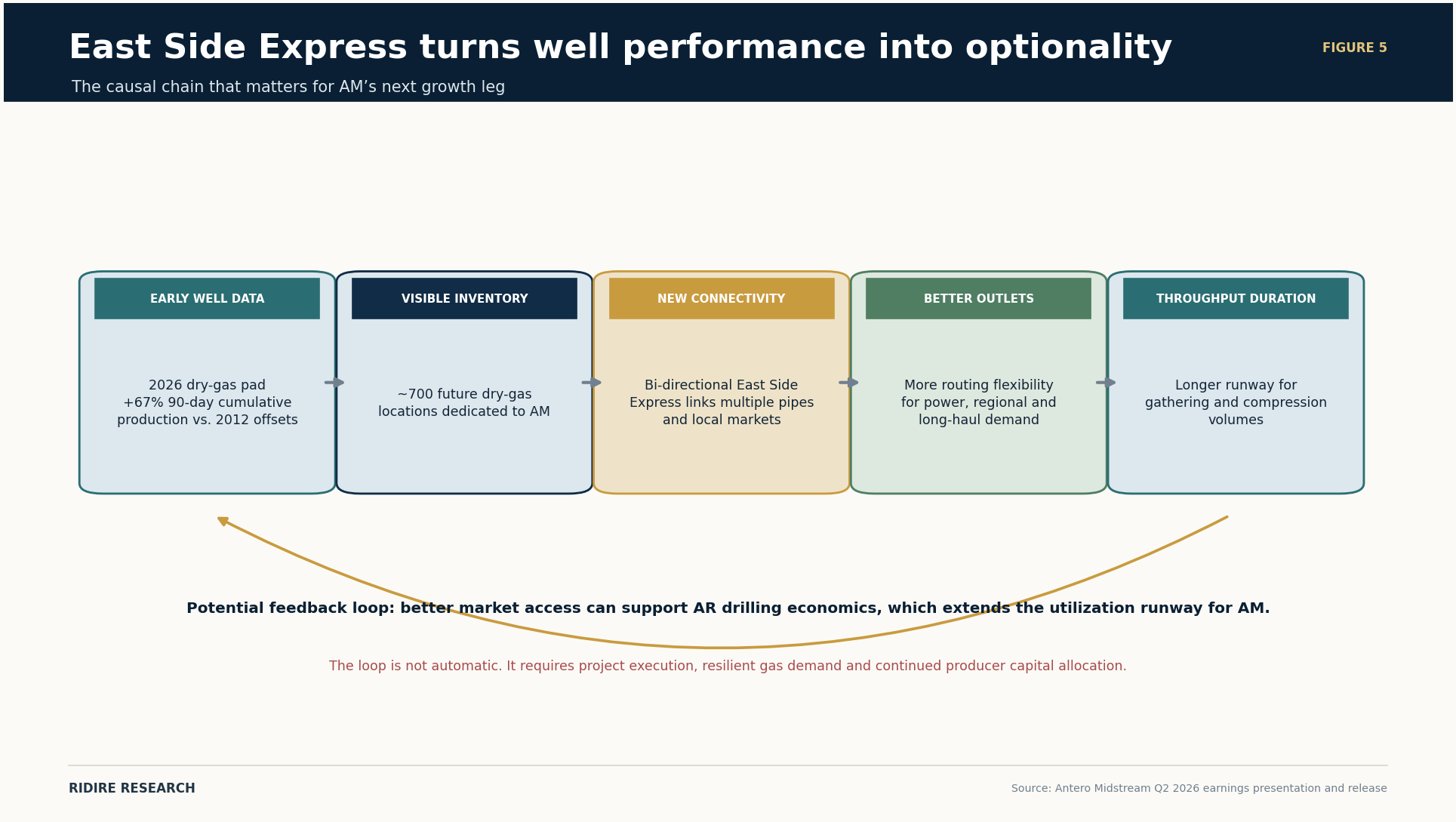
The feedback loop is potentially powerful:
Better wells support drilling → drilling fills gathering and compression assets → East Side Express creates additional market access → better market access supports development economics → AM earns fees across a longer inventory runway.
This is not guaranteed. AM has not disclosed in the public materials reviewed a final project capacity, total capital requirement or definitive commissioning date for East Side Express.
5. Balance-sheet capacity reduces timing risk
Infrastructure projects fail as often from financing constraints as from poor geology. AM’s balance-sheet reset changes the probability distribution.
The company received approximately $371 million in damages and interest from Veolia in July 2026. It used those proceeds and revolver borrowings to call the $650 million senior notes due in 2028 at par. On a pro forma basis, leverage fell to 2.8x, liquidity exceeded $600 million, and the nearest maturity moved to 2029.
The strategic benefit is durable: AM no longer needs East Side Express or the HG water integration to pay back immediately in order to avoid a near-term maturity problem. It can sequence the projects around operations rather than around a refinancing deadline.
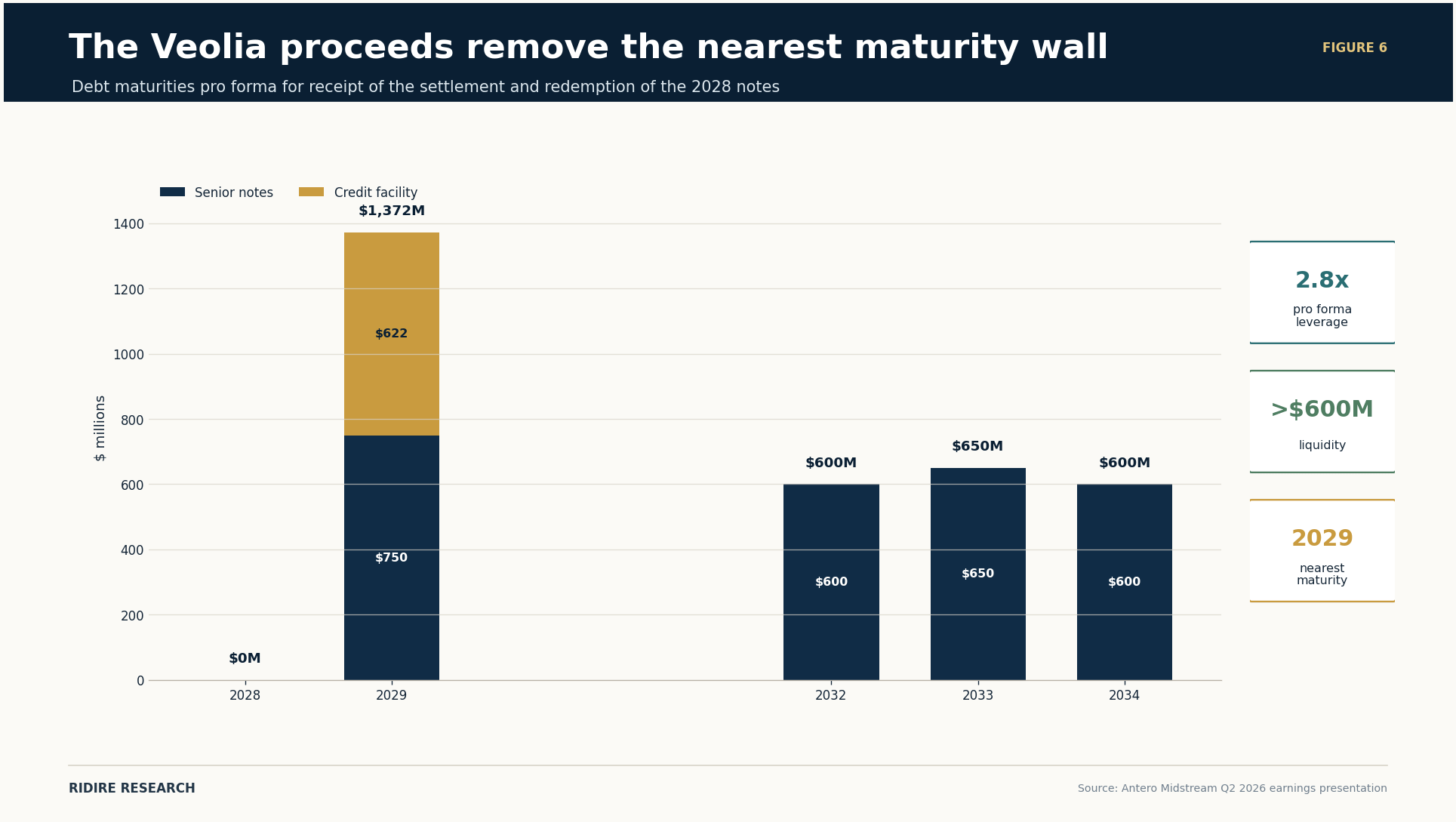
The company also generated $80 million of adjusted free cash flow after dividends in Q2, its twelfth consecutive positive quarter. Growth is useful only if AM can fund it without giving back the balance-sheet improvement.
Timeline
The key events are no longer hypothetical. AM has closed the transactions, received the litigation proceeds, retired the 2028 notes and begun East Side Express construction. The remaining questions concern integration and operating conversion.
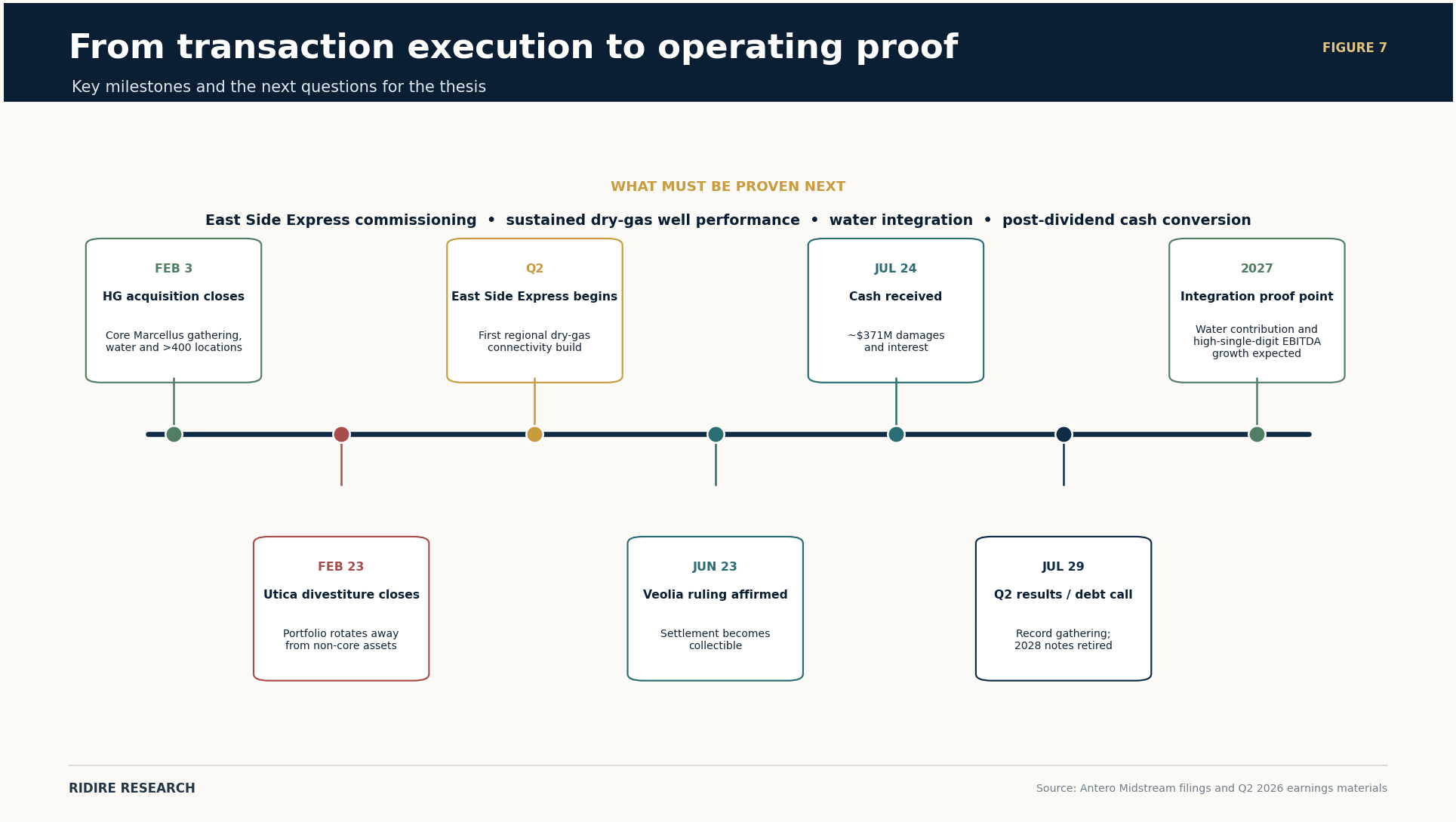
Second half of 2026 — Volume conversion test
Management expects higher gathering and water volumes to drive EBITDA growth in the back half. AR has also guided to higher sequential production. The key test is whether AM’s earnings growth begins to converge toward its volume growth as the acquired system is integrated.
2027 — Water integration becomes measurable
Management expects the water projects associated with the new footprint to help drive high-single-digit EBITDA growth in 2027. The quality of that growth matters more than the headline: pipeline-based service growth and margin conversion would be more important than cost-plus volume alone.
Key Risks
1. AR is the customer, counterparty and operating transmission mechanism
Substantially all of AM’s revenue is derived from AR. Any deterioration in AR’s production, drilling schedule, liquidity, leverage or operating performance can flow directly into AM’s throughput and cash generation. AR also owned 29% of AM at year-end 2025, and the companies share certain officers, directors and service arrangements.
2. Fixed fees do not eliminate commodity exposure
AM has little direct exposure to commodity prices, but AR does not. A prolonged deterioration in natural-gas or NGL economics could cause AR to reduce activity. Because low-pressure gathering and fresh-water pipelines generally lack minimum-volume commitments, lower drilling and completion activity would affect AM even if contracted fees remain unchanged.
3. Q2 volume growth was lower quality than the headline suggests
Gathering and compression volumes rose sharply, but adjusted EBITDA grew only 2%. Direct operating expense increased 34%. Other water handling grew 131%, but much of the increase came through cost-plus HG water, blending, trucking and disposal. AM must demonstrate that the acquired volume can be integrated into a more attractive service mix rather than simply adding revenue and expense in parallel.
4. East Side Express is still an under-specified project
The strategic logic is clear, but key project economics and operating milestones remain undisclosed in the public materials reviewed. Capacity, total capital, final in-service timing and firm commitments will determine whether East Side Express is a high-return extension of the existing system or a longer-dated capital project with uncertain utilization.
5. Processing capacity is full
AM’s processing and fractionation joint venture operated at 100% utilization in Q2. Full utilization supports current earnings but leaves limited spare capacity for additional rich-gas volumes.
6. Water remains completion-dependent
Fresh-water delivery declined 16% in Q2 because of the timing and location of AR’s completions. Water activity can move sharply between quarters, and the mix between fixed-fee delivery, cost-plus services, blending, trucking and disposal changes the margin outcome.
7. The balance-sheet improvement could be re-spent
The Veolia proceeds removed the nearest maturity and reduced leverage, but management now has greater capacity for growth projects, repurchases or additional transactions. A new acquisition cycle or a materially larger East Side Express budget could reverse the risk reduction before the operating benefits are proven.
Conclusion
The bear case sees one customer, one basin and a business whose activity ultimately depends on commodity economics. All three points are true. The bull case is not that these risks disappear. It is that the same concentration produces a coordinated infrastructure model with unusually high visibility into where, when and how the next wells will be developed.
AM entered 2026 with a gathering-and-water footprint built around AR’s legacy acreage. It now has a larger core Marcellus system, well-pad compression, integrated HG water assets and a first regional dry-gas connectivity project. The company has also removed its nearest maturity and preserved free cash flow after dividends through the transition.
The next phase is about conversion:
Can record gathering and compression volumes generate faster EBITDA growth as the acquired assets normalize?
Can the water business shift from activity growth to margin growth?
Can East Side Express turn dedicated dry-gas inventory into a regional connectivity advantage?
Can AM fund the buildout while preserving its post-dividend cash surplus and lower leverage?
If the answers are yes, the market will have to stop treating AM as a static captive gathering system. The company would still be tied to AR, but the tie would increasingly resemble a long-duration infrastructure schedule rather than a simple customer dependency. AM will remain concentrated. The question is whether that concentration continues to buy it better visibility, denser infrastructure and higher returns on the next dollar of capital.