


Affiliation Disclosure & Disclaimer:
The managing principal of Ridire Research is affiliated with a private investment fund that holds long positions in the securities discussed herein (YSS, RDW, BKSY, SPIR, LUNR, VOYG, VSAT, ONDS, UMAC) which could influence the views expressed. This publication is for educational and informational purposes only. Any performance referenced is illustrative and tracked on a per-article basis, not as part of a model portfolio or investment program. Nothing herein constitutes investment advice, a recommendation, or a solicitation. → Ridire Research Substack Disclaimer
Table of Contents
Executive Summary
Basket Overview
The Setup
Causal Mechanism
Timeline
Key Risks
Conclusion
Executive Summary
Space investors essentially are just multiplying large numbers by distant dates.
We would rather start with a procurement schedule:
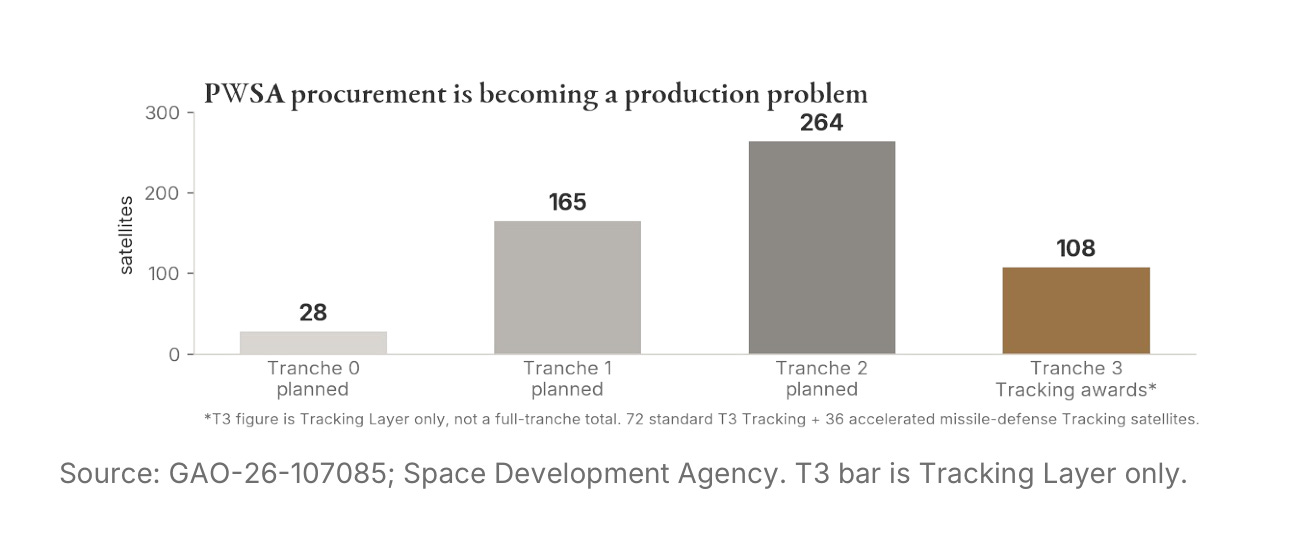

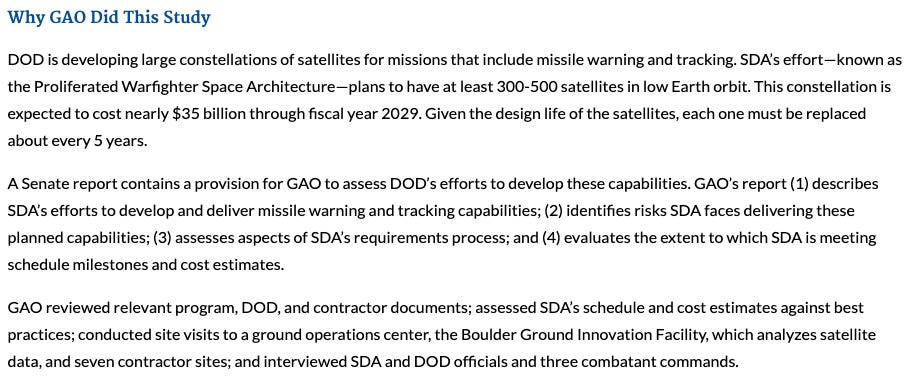
The Space Development Agency’s demonstration tranche called for 28 satellites.
GAO puts Tranche 1 at 165 and Tranche 2 at 264.
Since December, SDA has separately ordered 108 Tranche 3 Tracking satellites for about $5.25 billion.
This schedule is proof that a meaningful part of the architecture is now being bought in lots. Who actually makes money from this thematic is now more clear.
The old model rewarded years of engineering around one exquisite asset. The new one should reward platform reuse, supplier throughput and, eventually, the services that sit on top of a larger installed constellation.
However, government procurement can turn a sound industrial thesis into a bad quarter without changing the strategic demand at all. We are expressing the shift through an equal weight basket not because the businesses are equally good, but because the eventual profit pool is still unsettled/unclear.
Basket Overview
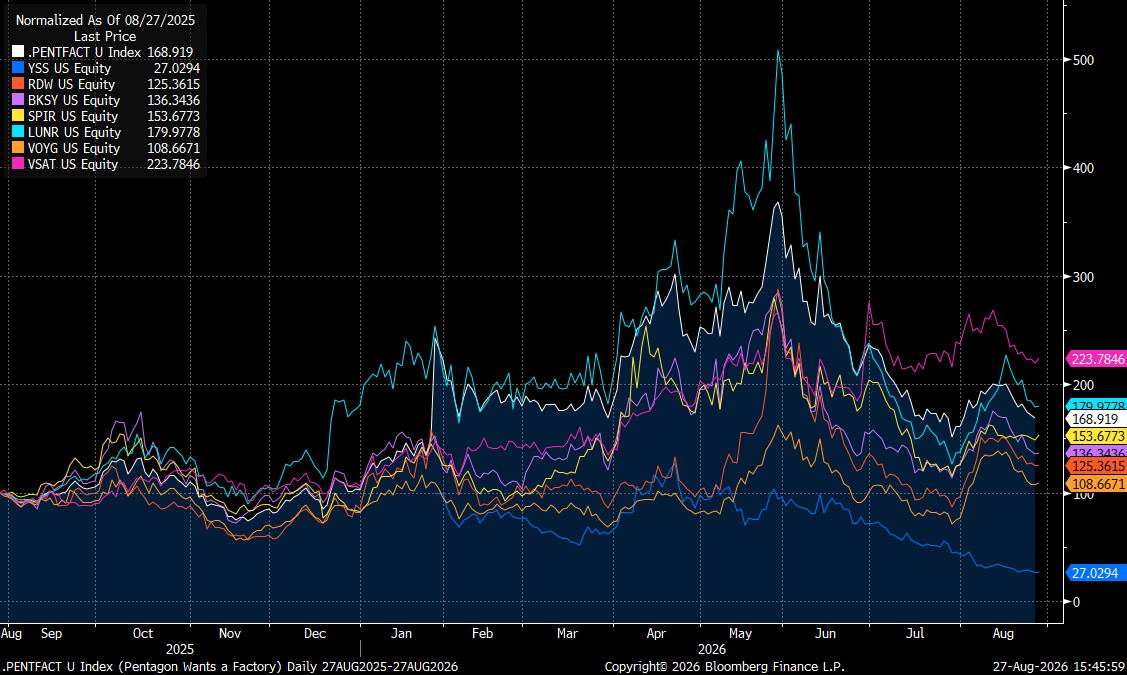
This section will be pretty brief as they are thematically linked, and can be further mapped to different layers within the thematic:

If the Pentagon is moving toward a larger, more frequently refreshed system, the margin does not have to stay with the company that bolts the actual satellite together.
A supplier can out-earn the prime, and a data business can earn better returns on the constellation than the company that built it. The next few quarters should tell us where the economics are settling.
The Setup
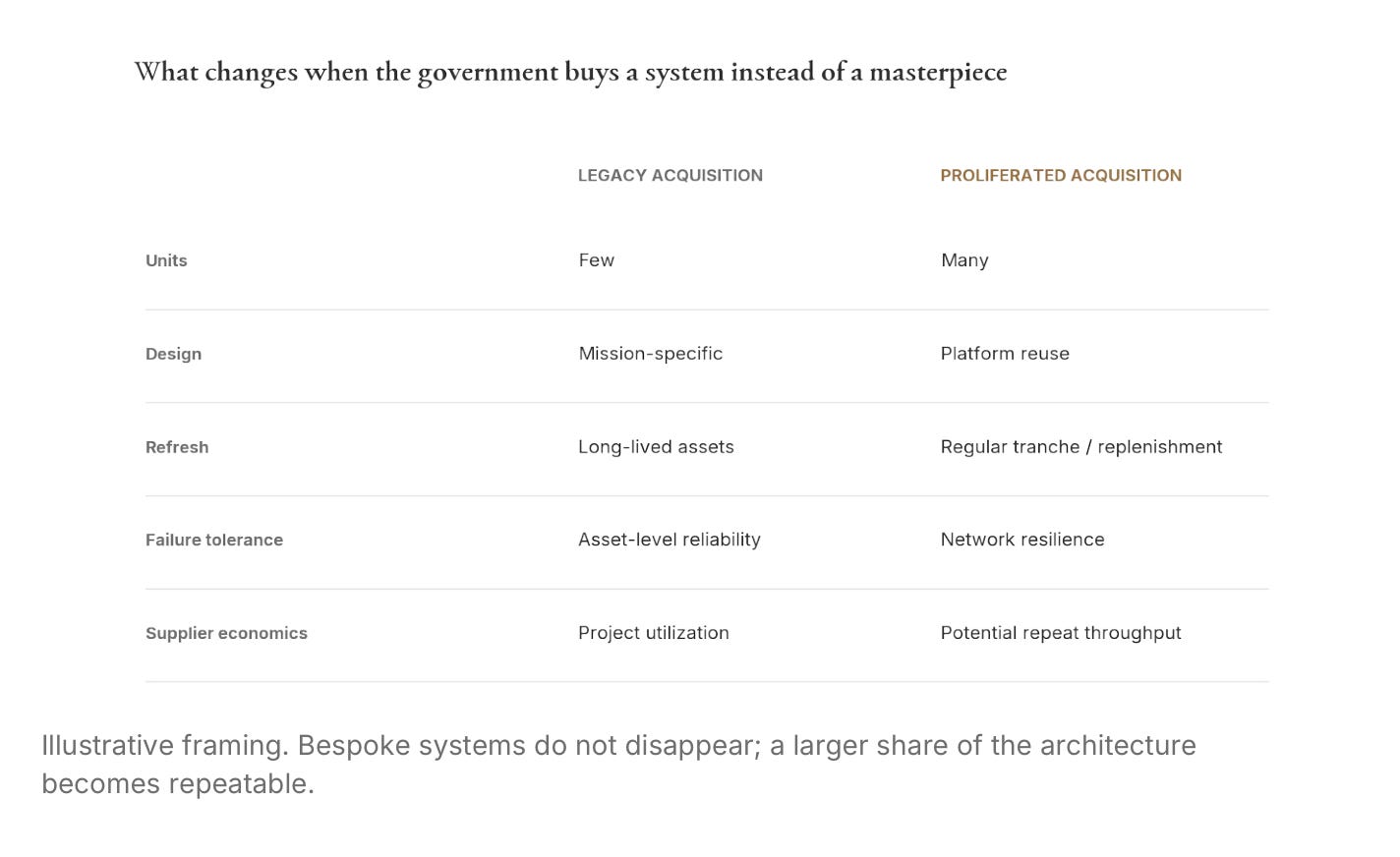
The setup is essentially the new cadence around an old mission. Missile warning, tactical communications and persistent intelligence have been strategic for decades but the willingness to distribute more of those functions across larger constellations and refresh the technology is what is new.
GAO says SDA plans tranche awards roughly every 2 years and expects each tranche to require replacement around 5 years after launch. SDA’s own Tranche 3 release describes targeted technology refreshes at roughly 2 year intervals. This is a very different demand pattern from a bespoke satellite designed once, nursed through a 10+ year program and then replaced by another bespoke satellite.
However, SDA has kept awarding new tranches while some technical elements and architecture-level schedules remain immature. Contractors have absorbed unplanned work. In other words, this is not your typical mass production scenario. It is an attempt to impose industrial cadence on a technically difficult system while the requirements are still moving.
This tension is good for public equities in the space though. Strategic urgency supports demand and capacity investment. Immature procurement and engineering make the path from award to revenue unusually noisy.
It also raises the value of common buses, repeatable payload integration, qualified components, automated testing, ground systems and data products that can be sold again after the satellite is already up. Conversely, it raises the cost of being late: a supplier that misses one tranche may wait for the next cycle while the factory it built sits underutilized.
It’s worth noting the shift toward repeatable hardware is not unique to space. The same procurement logic is already visible lower where the Pentagon is pushing inexpensive autonomous systems and domestic drone-component capacity:
Unusual Machines (UMAC) is scaling U.S. motor production from tens of thousands toward roughly 100,000 units per month.
While Ondas (ONDS) is assembling a broader portfolio around autonomous ISR, counter-UAS and precision strike.
They are not space exposures, but they are useful evidence that Washington increasingly values production capacity and replenishment alongside technical sophistication.
Causal Mechanism
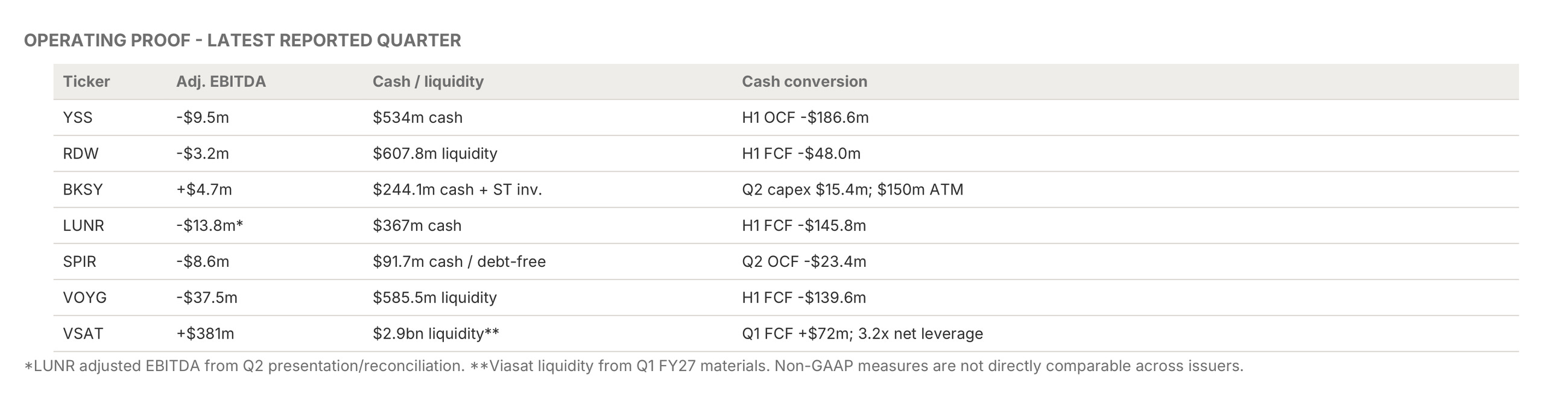
Volume alone is not enough. The thesis only works if repeat production actually lowers engineering intensity, improves utilization and, eventually, produces cash. So far, the financials are mixed:
York and Redwire are showing signs that manufacturing economics can improve, but both still illustrate how procurement timing and working capital can keep cash conversion weak.
BlackSky is beginning to show better service-layer economics, while Spire remains earlier in that transition.
Intuitive Machines and Voyager have substantial demand visibility, but both are still consuming significant cash; Voyager also carries the added burden of Starlab investment.
Viasat offers a useful picture of what a more mature version of the model can look like: less exciting growth, but clearer funded demand and actual free cash flow.
Awarded vehicles, options, unfunded scope and internal pipelines are often presented alongside firm work even though they carry very different levels of certainty. York, LUNR and Viasat all make that distinction visible in different ways: there is a meaningful gap between what has been identified, what sits on an awarded contract vehicle, what is included in reported backlog and what has actually been funded. The issue is that they should not be underwritten like committed revenue.

The investment case therefore comes down to a fairly mundane sequence: repeat orders, less engineering per unit, better gross margin, manageable working capital, then free cash flow per share. Any company can look good at step 1. The basket becomes interesting when 2 or 3 names start reaching step five without another financing in between.
On current evidence, RDW and BKSY have the cleanest operating proof, albeit for different reasons. RDW is showing industrial margin improvement across a broader defense/space portfolio; BKSY is showing that the data layer can scale at a higher incremental margin.
YSS remains the purest test of the factory thesis, but the 2026 guidance reset is exactly why purity and risk/reward are not the same thing. VOYG stays in the basket because propulsion, energetics and mission infrastructure are directly relevant to the capacity build.
Timeline
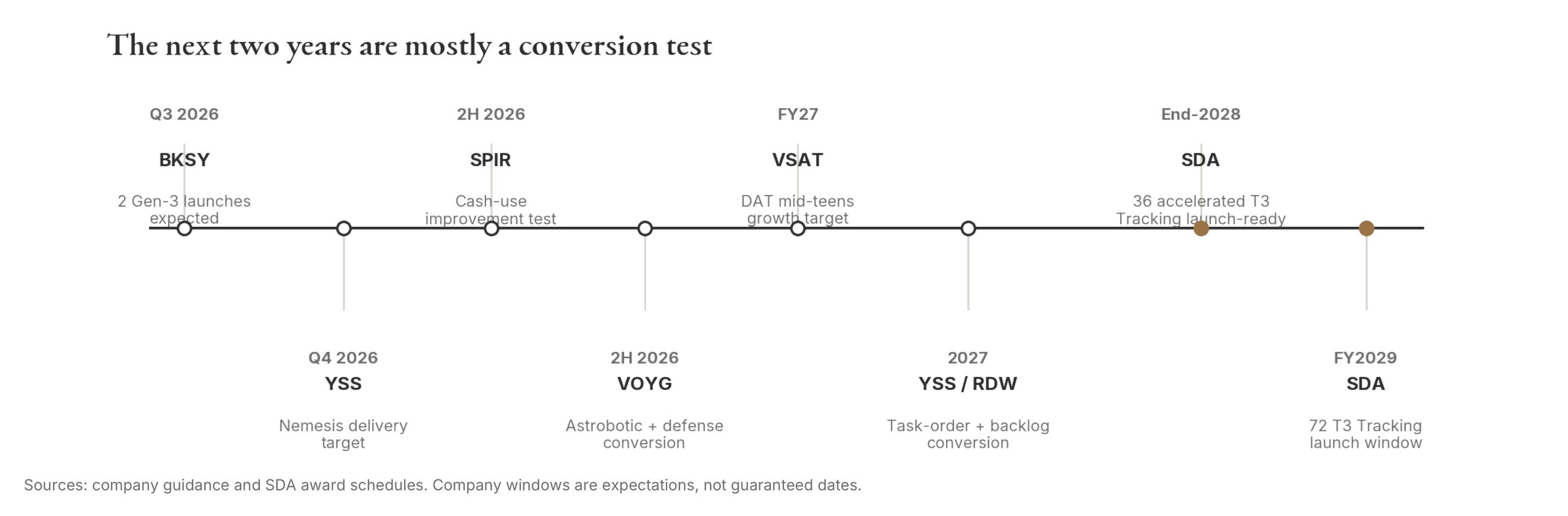
The next 12 to 24 months need evidence that the orders already being discussed can be built, billed and collected.
Late 2026 / 2027:
BKSY expects two Gen-3 satellites in Q3
YSS has Nemesis targeted for Q4
Spire expects sequential cash-use improvement.
In 2027 York task-order conversion, Redwire margin durability, Voyager integration and Viasat's mid-teens DAT growth target.
2028-2029:
SDA says the 36 accelerated Tranche 3 Tracking satellites should be launch-ready by end-2028
The 72 standard Tranche 3 Tracking satellites are scheduled for FY2029. By then the market should know whether frequent replenishment is an operating reality or just a planning convention.
Key Risks
Procurement timing: Continuing resolutions, task-order timing and protests can create the same mismatch elsewhere.
Engineering and fixed-price risk: SDA is deliberately pushing cadence before every technical element is mature. That can be good for volume and bad for contractor economics if the same “standard” platform keeps absorbing redesign work.
Backlog quality: The sector rewards big contract numbers. It should reward funded, executable work. Footnotes on all these companies should be carefully examined.
Capital intensity and dilution: YSS, BKSY, LUNR and others have recently relied on equity or IPO proceeds while building capacity. A successful program can still be a poor stock if shareholders repeatedly finance the working-capital gap.
Incumbents: Lockheed, Northrop, L3Harris and other traditional primes are already winning proliferated contracts. The architecture can change without the profit pool migrating entirely to newer public companies.
Correlation: In a procurement slowdown or risk-off tape, the basket will trade like one small/mid-cap defense-space factor long.
Conclusion
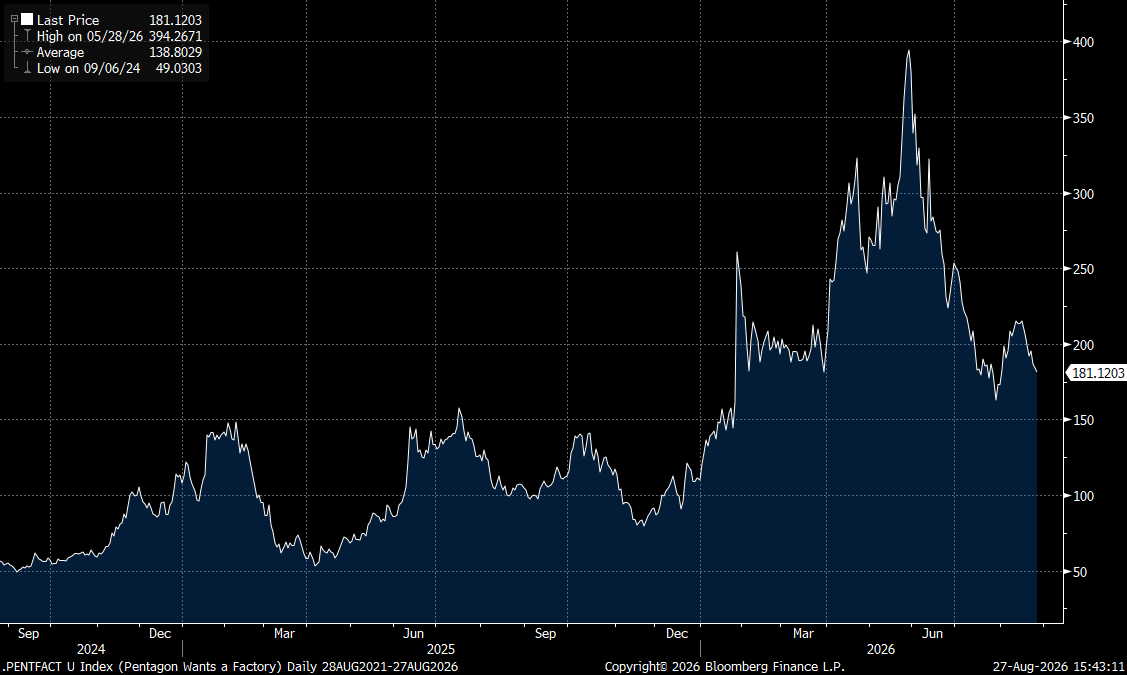
The public space trade used to mean giant defense primes or companies selling a very distant future. The current basket is more interesting because the government is already buying the architecture in repeatable generations, and public investors can own several points in the chain that supplies it.
The most important lesson from the latest quarters is that production cadence and shareholder cash flow are moving at different speeds:
YSS can put 21 satellites on orbit and still cut annual guidance.
RDW can post record margin and backlog while using free cash.
BKSY can show service leverage and still sell $150 million of stock.
LUNR can report $1.8 billion of backlog with parts of that backlog much less funded than the headline suggests.
If repeat awards begin to convert with less engineering intensity, better utilization and improving free cash flow per share, this stops being a collection of space stories and starts looking like an industrial category. But if the companies stay dependent on equity markets to bridge every new tranche, the Pentagon may still get its factory, but shareholders will have paid for it.