


Affiliation Disclosure & Disclaimer:
The managing principal of Ridire Research is affiliated with a private investment fund that holds long positions in the securities discussed herein (ECVT US) which could influence the views expressed. This publication is for educational and informational purposes only. Any performance referenced is illustrative and tracked on a per-article basis, not as part of a model portfolio or investment program. Nothing herein constitutes investment advice, a recommendation, or a solicitation. → Ridire Research Substack Disclaimer

Table of Contents
Executive Summary
Company Overview
The Setup
Causal Mechanism
Timeline
Key Risks
Conclusion
Executive Summary
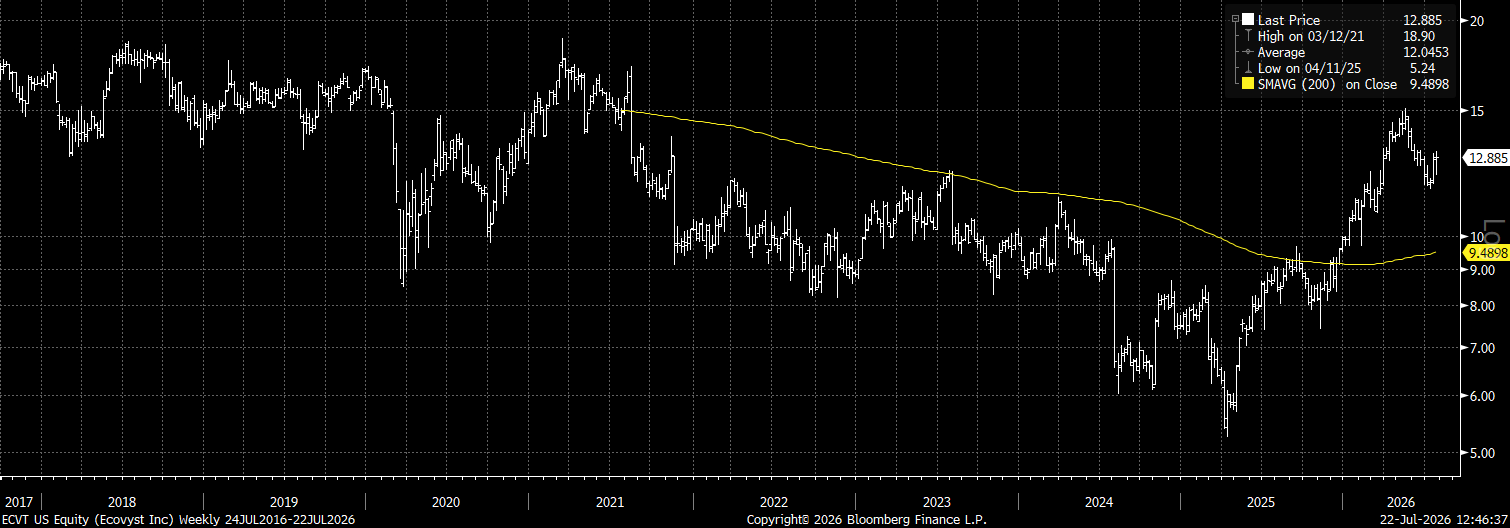
Ecovyst (ECVT US, $1.4b mkt cap) entered 2026 as a focused sulfur-services company. The Advanced Materials & Catalysts business was sold on December 31, 2025, and $465 million of the proceeds was used to repay term debt. Continuing operations now center on sulfuric acid regeneration, virgin sulfuric acid, industrial treatment services and catalyst activation. The June 30 acquisition of Calabrian added sulfur dioxide and related derivatives.
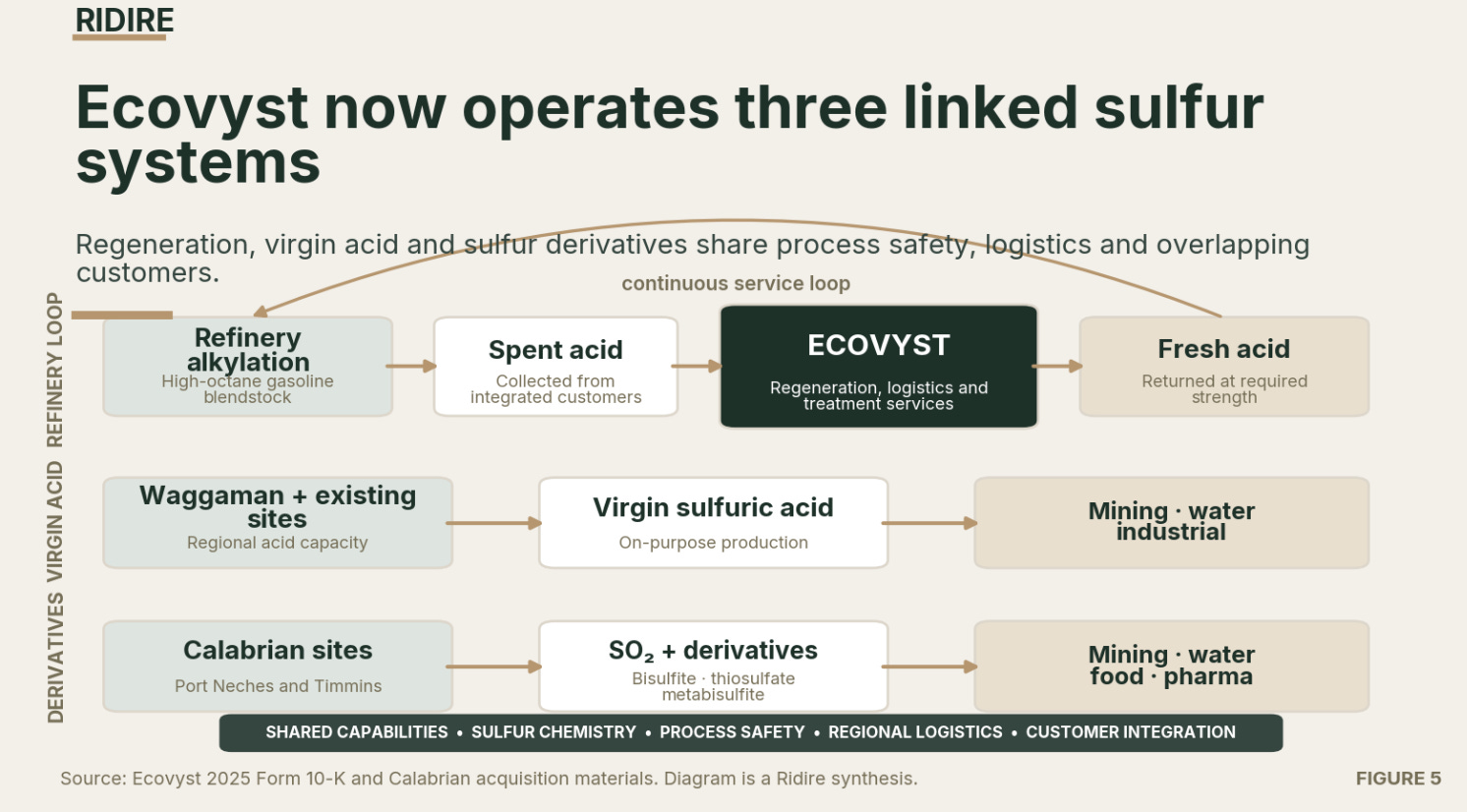
The core refinery service is a closed loop:
Sulfuric acid is used in alkylation units to produce alkylate, a high-octane gasoline component. The acid loses strength during the process.
Ecovyst collects the spent material, transports it to a regeneration plant, restores it and sends fresh acid back to the refinery.
Chemical production is only one part of the service. Logistics, plant reliability, customer integration and safe handling determine whether the loop runs without interruption.
The contract base is unusually important for an industrial company:
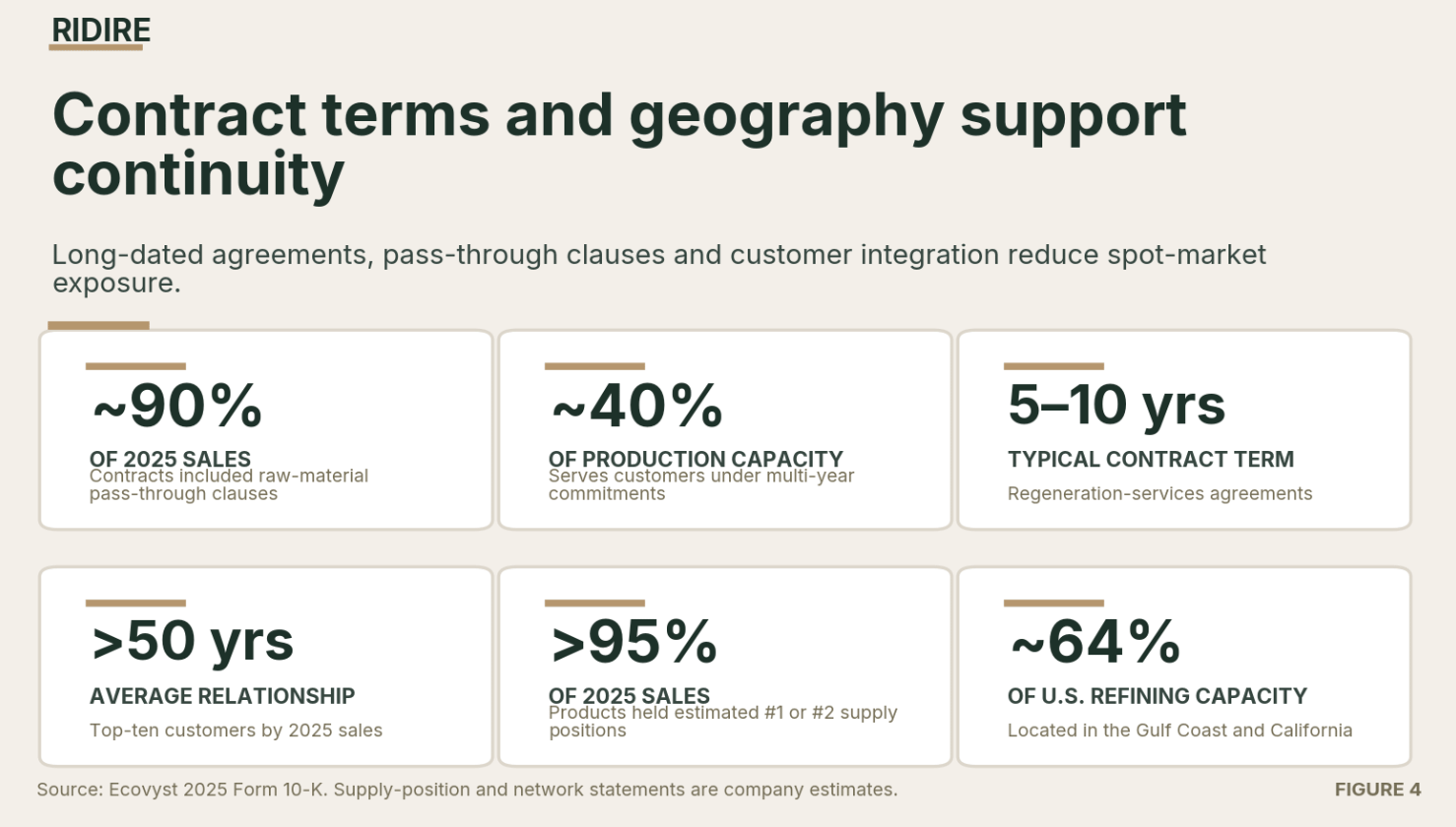
Approximately 90% of 2025 sales came from contracts with raw-material pass-through provisions.
Regeneration agreements typically run five to ten years, and roughly 40% of production capacity serves customers under staggered multi-year commitments.
Ecovyst reports that its top-ten customer relationships average more than 50 years. Those arrangements do not remove volume or operating risk, but they reduce direct exposure to spot pricing.
The financial position changed with the portfolio sale:
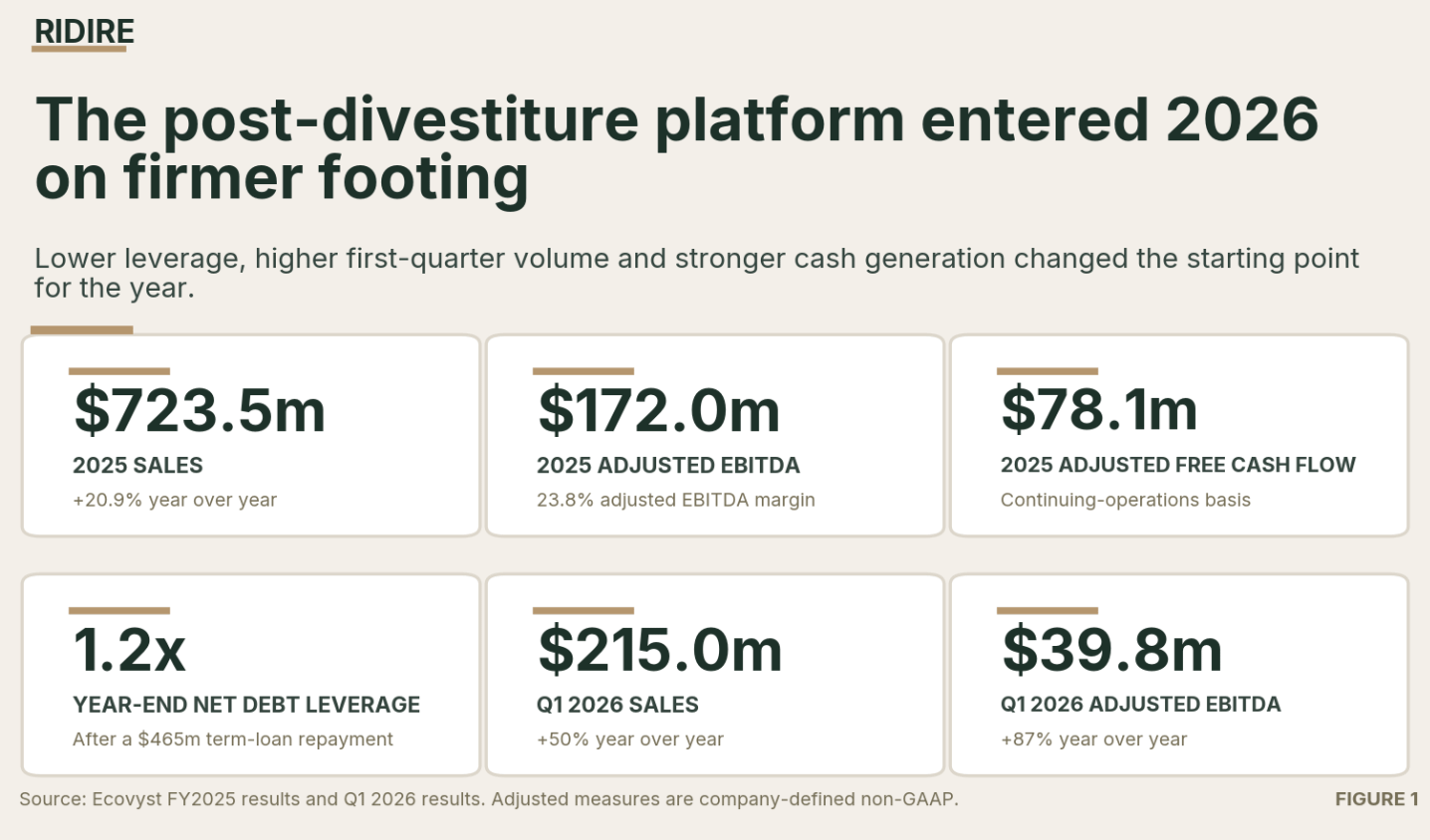
Full-year 2025 sales were $723.5 million, adjusted EBITDA was $172.0 million and adjusted free cash flow was $78.1 million. Year-end net debt leverage was 1.2x.
In the first quarter of 2026, sales increased 50% and adjusted EBITDA increased 87%. About $33 million of the quarterly sales increase came from sulfur-cost pass-through, so the reported growth rate overstates the underlying change.
Higher regeneration activity, more than 30% growth in virgin-acid volume and favorable contract pricing still produced a clear improvement in gross profit, EBITDA and cash flow.
Calabrian expands the product range without moving Ecovyst far from its existing operating skill set. The acquired sites in Port Neches, Texas, and Timmins, Ontario, produce sulfur dioxide, sodium bisulfite, sodium thiosulfate and sodium metabisulfite for mining, water treatment, specialty chemicals, food processing and pharmaceuticals. The first scheduled earnings update after closing is August 5. Because the transaction closed on the final day of the quarter, second-quarter results will contain little operating contribution from Calabrian. The more useful information will be the consolidated outlook, integration plan, leverage bridge and current demand commentary.
Figure 1 — Ecovyst entered 2026 with lower leverage and stronger first-quarter operating results.
Company Overview
Ecovyst now operates across four connected activities:
Sulfuric acid regeneration is the largest source of operating identity. Refineries use sulfuric acid in alkylation, then send the spent acid to Ecovyst for regeneration. Ecovyst manages collection, transport, processing and return delivery. Some customers are connected by captive pipeline; others are served by barge, rail or truck. The service is tied to refinery utilization, alkylate economics and customer turnaround schedules.
Virgin sulfuric acid supplies mining, municipal and industrial water treatment, chemicals, construction materials and other process industries. The Waggaman assets acquired in May 2025 added Gulf Coast production capacity. Management attributed part of the first-quarter 2026 volume increase to Waggaman and said total virgin-acid volume grew more than 30% from the prior year.
Treatment services and Chem32 add related process capabilities. Ecovyst treats hazardous and non-hazardous industrial waste and provides ex-situ sulfiding and activation for hydro-processing catalysts used in conventional and sustainable fuels.
Calabrian broadens the portfolio into sulfur dioxide and derivatives. The overlap is practical: sulfur chemistry, process safety, industrial logistics and many of the same end markets. The acquired product groups serve mining and water treatment while adding food-processing, pharmaceutical and specialty-chemical applications.
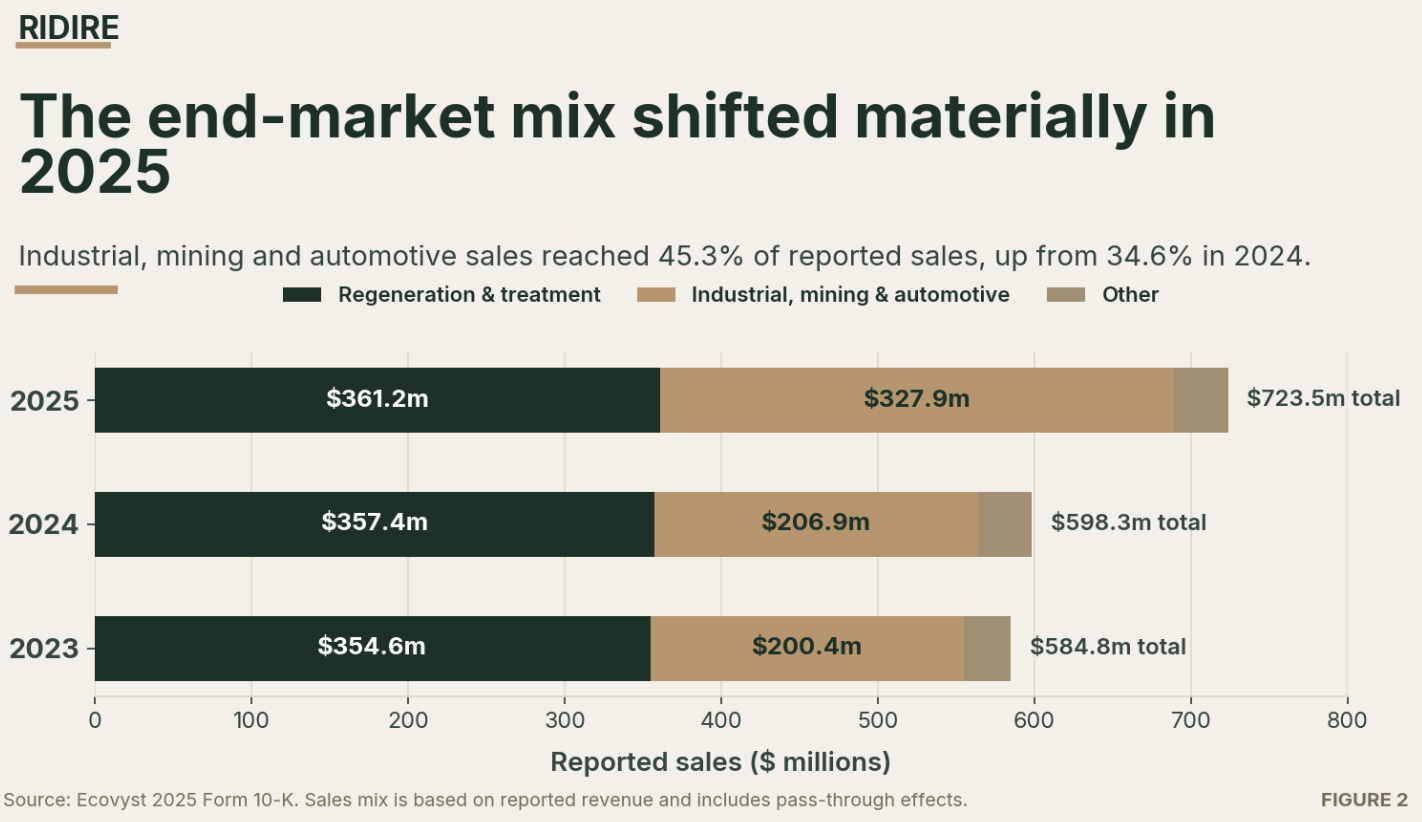
Before Calabrian, 2025 reported sales were split between regeneration and treatment services at 49.9%, industrial, mining and automotive uses at 45.3%, and other uses at 4.8%. Industrial, mining and automotive sales rose sharply from 2024, partly because of higher sulfur-cost pass-through and the Waggaman contribution.
Figure 2 — Industrial, mining and automotive uses represented a much larger share of reported sales in 2025.
The Setup
Reported revenue can move faster than the underlying economics. Most contracts allow Ecovyst to pass changes in sulfur, freight and other cost inputs through to customers. When sulfur prices rise, sales and cost of goods sold rise together. Gross profit, adjusted EBITDA and cash flow provide a cleaner view of operating progress.
The 2025 figures show the difference:
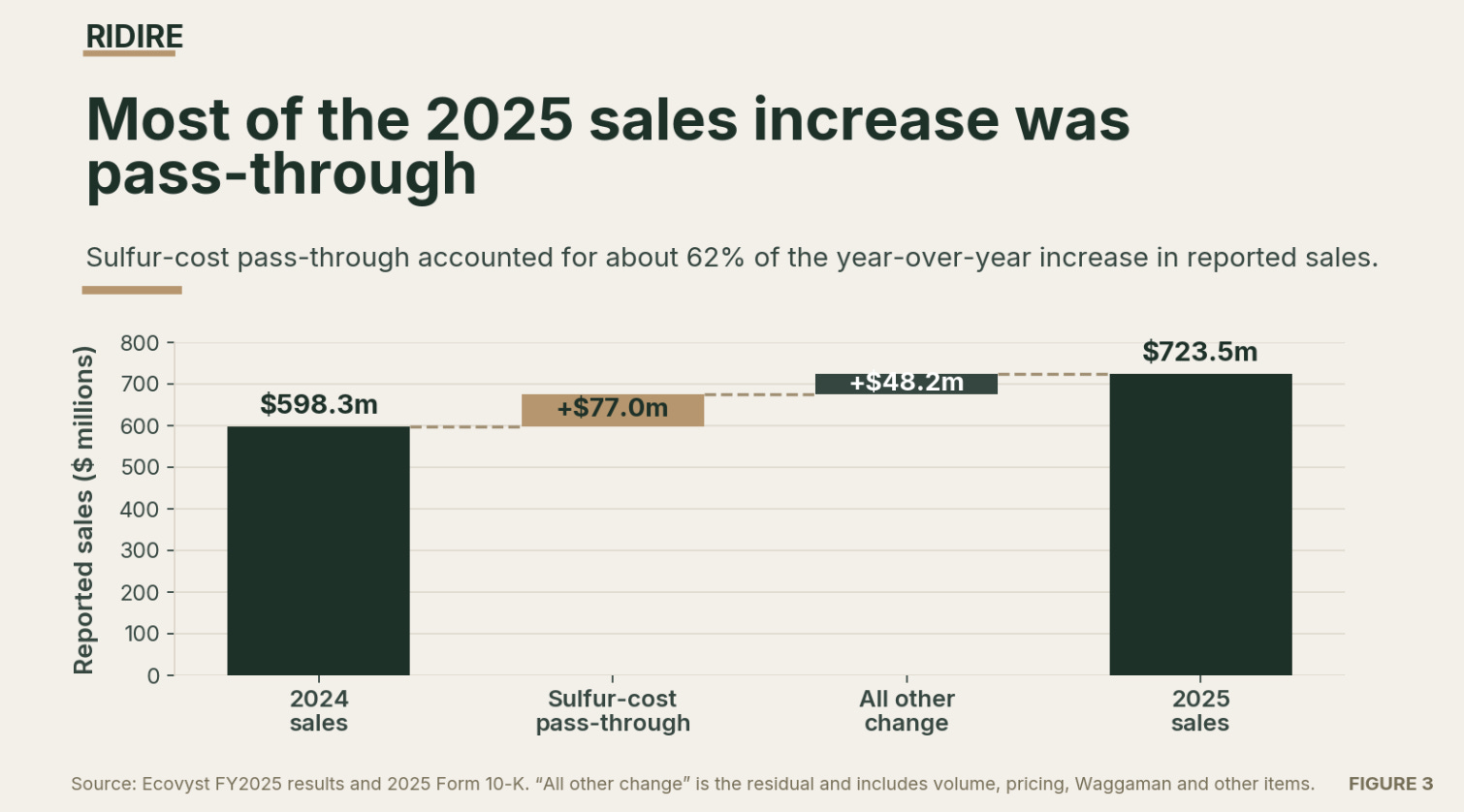
Sales increased from $598.3 million to $723.5 million, a gain of $125.2 million. Ecovyst disclosed that approximately $77 million of the increase came from sulfur-cost pass-through. The remaining $48.2 million reflects the combined effect of volume, contract pricing, Waggaman and other changes.
Adjusted EBITDA was $172.0 million, compared with $172.7 million in 2024. Higher pricing and virgin-acid volume were offset by lower regeneration volume, customer downtime, maintenance, inflation and transportation costs.
Figure 3 — Sulfur-cost pass-through represented about 62% of the 2025 sales increase.
The first quarter of 2026 was stronger:
Regeneration-services sales grew at a double-digit rate as refinery utilization remained high, alkylate economics were favorable and customer downtime improved from the prior-year period.
Virgin-acid volume increased more than 30%. Adjusted EBITDA rose to $39.8 million from $21.3 million, while adjusted free cash flow improved to $4.2 million from negative $13.0 million.
The same revenue adjustment still applies:
Of the $71.9 million increase in quarterly sales, approximately $33 million came from sulfur-cost pass-through.
Even after separating that amount, the quarter showed higher volume and favorable pricing. Gross profit increased to $36.4 million from $19.1 million, which confirms that the improvement was not limited to revenue presentation.
Management’s May outlook called for 2026 sales of $890 million to $970 million, adjusted EBITDA of $180 million to $195 million, adjusted free cash flow of $40 million to $55 million and capital spending of $80 million to $90 million. The sales range assumed approximately $155 million of sulfur-cost pass-through. The outlook was issued before Calabrian closed and did not provide a full combined-company bridge. August should clarify the post-close earnings base and capital requirements.
Causal Mechanism
Ecovyst’s economics begin with geography:
Sulfuric acid is costly and operationally demanding to transport, so the business is regional. Ecovyst’s network is concentrated in the Gulf Coast and California, where approximately 64% of U.S. refining capacity is located.
The company can deliver by barge, rail, truck and, in certain cases, captive pipeline. A new supplier would need more than production capacity. It would need permits, transport access, sulfur-handling expertise, a record of safe operation and facilities close enough to customer demand.
Regional assets reduce logistics risk
Refinery alkylation is a continuous industrial process. Spent acid must be removed and regenerated acid must return at the required strength and schedule. Delays can affect the customer’s operating plan. Location and logistics therefore carry economic weight even when the underlying molecule is standardized.
The Waggaman assets fit this network:
They add regional acid capacity in Louisiana rather than introducing a remote product line.
Ecovyst is also investing in two projects intended to serve a growing virgin-acid customer base.
But the relevant test is utilization: incremental capacity should translate into volume, contribution margin and cash generation without creating an excessive maintenance burden.
Contract provisions stabilize spreads
Most Ecovyst contracts include minimum-volume protection, quarterly price adjustments or both. Approximately 90% of 2025 sales occurred under contracts with some form of raw-material pass-through. Freight is generally passed directly to customers. Regeneration contracts typically run five to ten years, while virgin-acid contracts generally run one to five years. Roughly 40% of production capacity serves customers with staggered multi-year commitments.
These provisions reduce the effect of raw-material inflation on unit economics, although timing differences and contract disputes can still affect a quarter. They also make the sales line less informative when sulfur prices change quickly.
Customer integration supports retention
Ecovyst reports that products representing more than 95% of 2025 sales held an estimated number-one or number-two supply position.
Its top-ten customer relationships average more than 50 years.
Both figures are company statements, but the operating context supports the conclusion that switching is not frictionless. A refinery replacing its regeneration provider must rework logistics, quality controls and operating coordination around a process that cannot tolerate unreliable supply.
The service represents a small portion of a customer’s finished-product cost while remaining necessary to production. That combination can support durable relationships and pricing discipline. It does not eliminate customer bargaining power; the top ten customers represented 61% of 2025 sales, so concentration remains an important counterweight.
Figure 4 — Long contracts, pass-through terms and regional assets support continuity.
Calabrian adds adjacent chemistry
Calabrian gives Ecovyst a second sulfur platform:
The acquired business produces sulfur dioxide and derivatives at two North American sites.
The end markets overlap with Ecovyst’s existing mining and water-treatment exposure and add food-processing, pharmaceutical and specialty-chemical uses.
The integration case rests on operating overlap rather than a broad diversification claim:
Ecovyst already handles sulfur inputs, hazardous materials, continuous-process plants and regional industrial logistics.
Commercial overlap may also create cross-selling opportunities, but management has not yet provided enough post-close detail to treat those benefits as established.
Figure 5 — Regeneration, virgin acid and sulfur derivatives use a common set of industrial capabilities.
Timeline
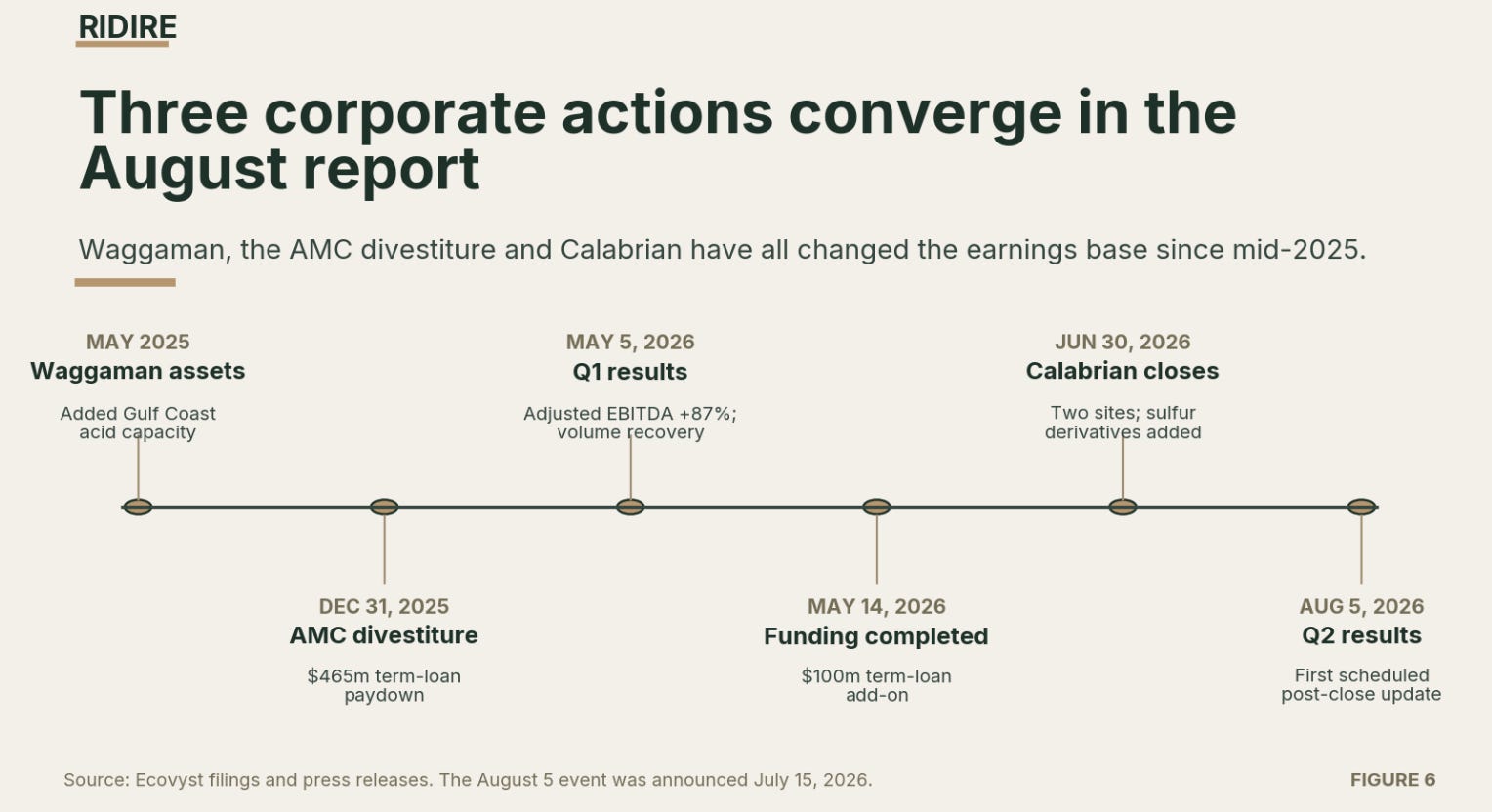
The portfolio changed quickly over the last fourteen months:
Waggaman added Gulf Coast capacity in May 2025.
The Advanced Materials & Catalysts sale closed at year-end, followed by a $465 million term-loan repayment.
First-quarter 2026 results showed improved volume and pricing.
Ecovyst then completed a $100 million term-loan add-on in May and closed Calabrian on June 30.
Figure 6 — Waggaman, the divestiture and Calabrian all feed into the August 5 update.
Five items deserve close attention on August 5:
1. A combined-company outlook. The May guidance was issued before the acquisition closed. Investors need a bridge from stand-alone Ecovyst to the post-close sales, EBITDA, cash-flow and capital-spending ranges.
2. Calabrian integration costs and milestones. The transaction closed at quarter-end, so the income statement will say little about operating contribution. Management commentary should identify near-term costs, plant priorities, customer retention and the timing of any commercial or procurement benefits.
3. Waggaman utilization. First-quarter virgin-acid volume was strong. The next report should show whether the increase continued, which end markets drove it and how the two growth projects affect capacity and capital spending.
4. Regeneration uptime. Lower customer downtime helped first-quarter results. Refinery turnarounds and unplanned outages can move quarterly volume materially, so current schedules matter.
5. Cash conversion and leverage. Capital spending remains elevated, and the Calabrian financing increased debt from the post-divestiture low. EBITDA growth needs to convert into free cash flow after maintenance, growth projects, interest and integration spending.
Key Risks
The main risks can be observed directly in operating data.
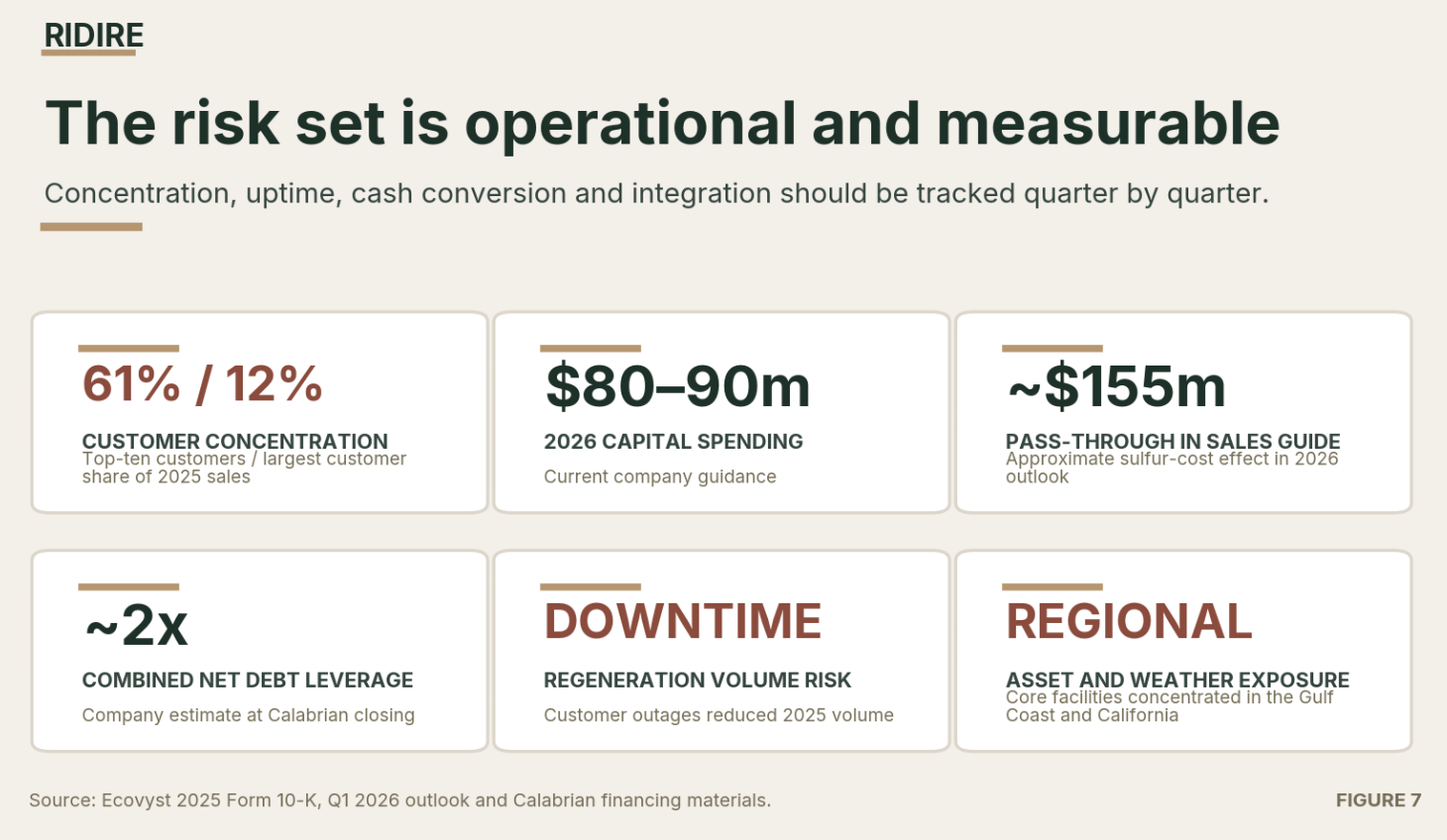
Customer concentration: The top ten customers represented approximately 61% of 2025 sales, and the largest customer represented 12%, or $89 million. Further refinery consolidation could strengthen customer bargaining power.
Customer downtime and turnarounds: Extended outages reduced regeneration volume in 2025. Similar events can affect sales, plant utilization and transportation costs.
Pass-through presentation: Higher sulfur prices can create rapid reported sales growth without a comparable increase in gross profit. The 2026 sales outlook includes approximately $155 million of sulfur-cost pass-through.
Capital intensity: The current 2026 capital-spending range is $80 million to $90 million. Maintenance, environmental and process-safety spending are necessary parts of the business.
Calabrian integration: The acquisition adds two sites, a Canadian operation, new product groups and purchase-accounting complexity. Customer retention, safe plant operation and integration discipline will determine the result.
Balance-sheet re-expansion: Ecovyst funded part of Calabrian with a $100 million floating-rate term-loan add-on. Management estimated combined net debt leverage of approximately 2x at closing.
Regional exposure: Gulf Coast facilities face hurricanes and freezes; California facilities face earthquakes and wildfires. Concentrated assets improve logistics but raise exposure to regional disruptions.
Refining exposure: Regeneration demand remains linked to refinery utilization and alkylate production. Long-run changes in gasoline demand, refinery capacity or fuel specifications could affect the service base.
Figure 7 — Concentration, capital spending, pass-through and operating continuity are the central monitoring points.
Conclusion
Ecovyst’s quarterly results will continue to reflect refinery outages, maintenance schedules, sulfur prices and industrial demand. Those variables are part of the business rather than temporary noise. The investment case depends on whether the regional network, contract structure and customer relationships produce stable margins and cash generation across those fluctuations.
Three measures provide a practical scorecard:
First, underlying volume should grow after removing sulfur-cost pass-through.
Second, adjusted EBITDA should reflect the benefit of higher utilization and contract pricing.
Third, adjusted free cash flow should remain credible after capital spending and integration costs.
The August 5 report will add a fourth test: management must explain how Calabrian changes the earnings base, capital requirements and leverage path. A useful update will separate stand-alone Ecovyst performance from acquisition effects and give investors concrete milestones for the two acquired sites.
Refineries rely on acid regeneration to keep alkylation units operating. Mining, water-treatment and specialty customers rely on dependable regional supply of sulfur-based chemicals. Ecovyst earns its place in those processes through plants, logistics, contracts and an operating record built over decades. The next stage is to show that the broader sulfur portfolio can improve cash generation without weakening that operating discipline.